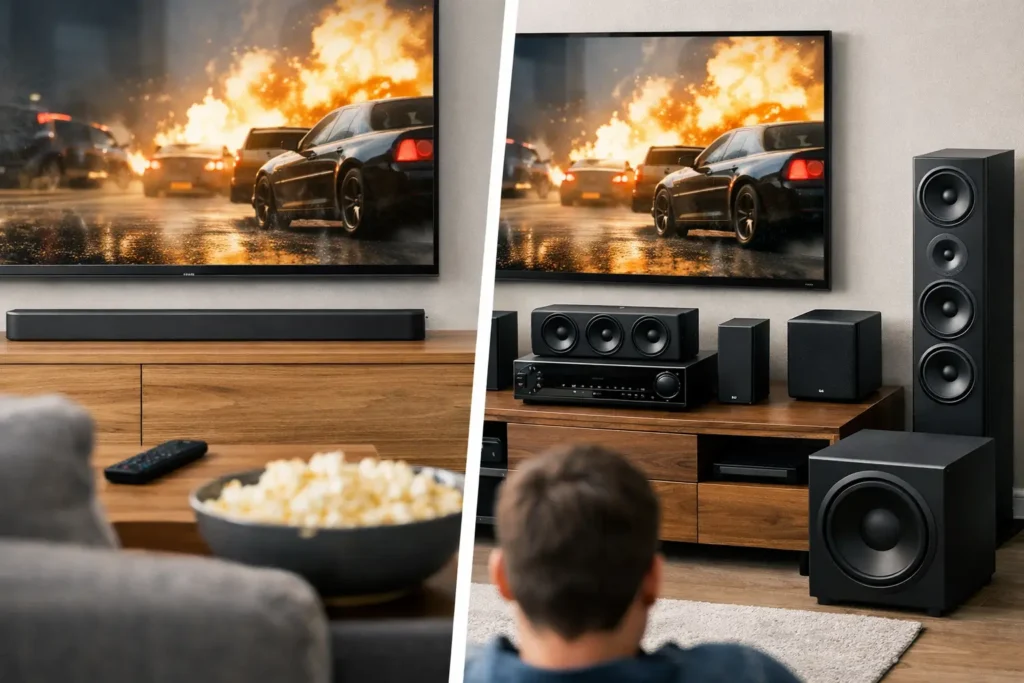
A movie night can go sideways fast when the picture looks great but the audio feels thin, flat, or hard to follow. That is why the soundbar vs surround sound question matters more than most people expect. The right choice affects not just volume, but dialogue clarity, bass impact, room layout, wiring, and how much you actually enjoy using the system every day.
For some homes, a soundbar is exactly the right answer. For others, it solves one problem while creating a few new ones. Surround sound can deliver a much bigger experience, but it also asks more from the room, the budget, and the installation. The best option depends on how you watch, where the system is going, and how clean you want the final setup to look.
Soundbar vs surround sound at a glance
A soundbar is the simpler path. It usually sits below the TV, uses fewer components, and can be installed quickly. Many newer models include wireless subwoofers, voice enhancement, and virtual surround processing that improves the experience far beyond built-in TV speakers.
Surround sound is built for immersion. Instead of trying to simulate space from one front speaker bar, it uses multiple speakers placed around the room. That gives sound effects a more realistic sense of movement and makes movies, sports, and gaming feel bigger and more convincing.
If your main goal is better everyday TV audio with minimal clutter, a soundbar often makes sense. If you want your living room or media room to feel more like a theater, surround sound is usually the stronger investment.
When a soundbar makes more sense
A soundbar is often the right fit for homeowners who want noticeable improvement without turning the room into a project. It works well in bedrooms, secondary living spaces, condos, and family rooms where simplicity matters just as much as performance.
The biggest advantage is ease. A good soundbar setup can be clean, compact, and fast to install. In many cases, you are dealing with one main speaker, one HDMI connection, and maybe a wireless subwoofer. That is appealing if you want better sound but do not want speaker wire running across the room or equipment stacked in a cabinet.
Soundbars also make sense when the room itself limits your options. Open-concept spaces, heavy foot traffic, large windows, and furniture layouts can make proper rear speaker placement difficult. In those situations, a soundbar may be the most practical way to improve audio without fighting the room.
That said, there are trade-offs. Even very good soundbars have limits when it comes to true separation and depth. Virtual surround modes can help, but they do not fully replace dedicated side and rear speakers. If you care about hearing a helicopter move overhead or a crowd swell from behind you, a soundbar can only go so far.
When surround sound is worth it
Surround sound earns its place when performance is the priority. If you regularly watch movies, stream concerts, host game days, or want a space that feels more cinematic, separate speakers will almost always outperform a single bar.
The key difference is real speaker placement. Front left, center, and right speakers create a wider and more precise soundstage. Rear or side surrounds add envelopment. A dedicated subwoofer handles low-end impact better than the compact drivers built into most bars. If you step up to Dolby Atmos, overhead effects can add another layer of realism.
This is especially noticeable in larger rooms. A soundbar may sound decent near the couch but struggle to fill the full space evenly. A properly designed surround setup can be tuned to the room, the seating positions, and the way the system will actually be used. That creates a more balanced result, not just a louder one.
Surround sound is also a better long-term choice for homeowners who plan to upgrade over time. You can start with a solid 5.1 setup and improve components later. With a soundbar, you are usually buying into a more closed system.
The real question is your room
Most buying advice online treats this like a simple product comparison. In real homes, the room decides a lot.
A smaller room with a single seating area may do very well with a premium soundbar and subwoofer. A large great room with tall ceilings and seating spread across the space usually benefits from separate speakers. If the sofa is pushed against the back wall, rear speaker placement gets trickier. If the TV is mounted above a fireplace, that may affect both speaker position and dialogue clarity.
This is where professional planning helps. A system that looks perfect on paper can underperform if the speaker angles are wrong, the room reflects too much sound, or the subwoofer ends up in a dead spot. On the other hand, a carefully installed soundbar can outperform a poorly arranged surround system.
Cost is not just the equipment price
A soundbar usually wins on upfront cost. It often includes amplification, processing, and multiple speaker channels in one unit. That makes it attractive for homeowners who want a clean upgrade without a larger investment.
Surround sound usually costs more because there are more parts involved. You may need an AV receiver, front speakers, surrounds, a subwoofer, mounting hardware, cabling, and setup time. If you want in-wall or in-ceiling speakers, that adds labor and planning.
But cost should be measured against results. A cheaper system that leaves you frustrated with weak dialogue or uneven sound is not really the better value. Likewise, overspending on a complex surround setup for a casual TV room may not be necessary. The right budget depends on the space and your expectations.
Clean design matters more than people think
In many Southern California homes, appearance matters almost as much as audio performance. People want strong sound, but they also want a finished room that still feels refined and uncluttered.
This is one reason soundbars remain popular. They are easy to integrate visually. Mounted neatly under a TV with concealed wiring, they can look intentional and low-profile.
Surround sound can also look clean, but it usually takes more planning. Speaker placement, wire paths, equipment storage, and control systems need to be thought through early. When done right, the room does not feel crowded or overly technical. It just sounds better. Tri Star Home Theater often works with homeowners who want that higher-end performance without sacrificing the look of the space.
Setup, control, and daily use
A system is only good if people actually enjoy using it. That is another area where soundbars have an advantage. They are generally easier for the whole household to operate. Fewer devices, fewer inputs, and fewer opportunities for someone to hit the wrong button.
Surround sound has more moving parts, but it does not have to be complicated. With proper programming and setup, a surround system can be very user-friendly. The trouble starts when components are mismatched, source devices are not configured correctly, or the room was never calibrated. Then the homeowner ends up fighting the system instead of enjoying it.
Ease of use should be part of the decision, especially in family rooms where multiple people use the TV every day.
Soundbar vs surround sound for different use cases
For everyday streaming, news, and casual TV, a soundbar is often enough. It gives clearer dialogue and fuller sound without demanding much space or attention.
For movie lovers, serious gamers, and anyone building a dedicated entertainment area, surround sound usually delivers the experience they were hoping for in the first place. It creates dimension that a soundbar can imitate but not fully match.
For mixed-use spaces, the answer depends on priorities. If the room must stay visually minimal and installation needs to be quick, a soundbar may be the smarter fit. If the room is being remodeled or pre-wired, that is often the perfect time to consider surround sound because the installation can be done cleanly from the start.
What we usually tell homeowners
Do not choose based on marketing terms alone. Choose based on room size, seating layout, viewing habits, and how much performance you will actually notice and appreciate.
If you want a straightforward upgrade and a clean look, buy the best soundbar that fits the room and install it properly. If you want real immersion and you care about how a movie sounds as much as how it looks, surround sound is usually the better answer.
There is no single winner in the soundbar vs surround sound debate. There is only the system that fits your home, your habits, and your expectations without making daily use harder than it should be.
The smart move is to think beyond the product box. Consider the room, the wiring, the control, and the finished look. That is what turns good equipment into a setup you will still be happy with a year from now.
Ready for a free consultation? Let’s get in touch! Call (949) 878-0531 Today