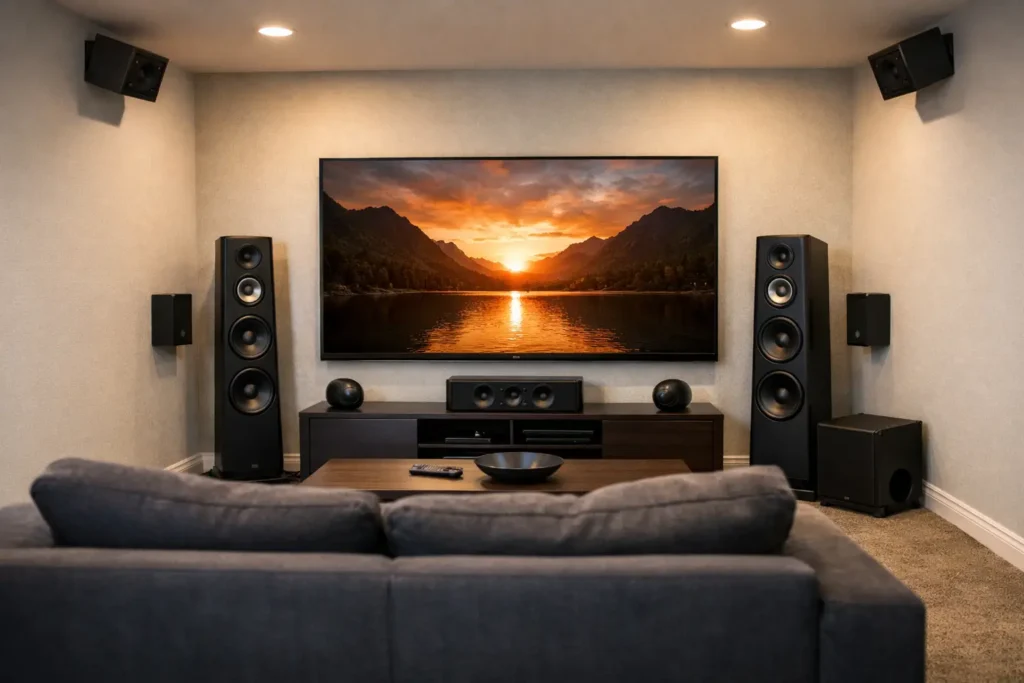
A beautiful TV wall and high-end speakers can still sound disappointing if the room is working against you. That is why a smart home theater speaker placement guide matters so much. Placement affects dialogue clarity, bass balance, surround immersion, and how comfortable the whole room feels when you actually sit down to watch a movie.
Most sound problems homeowners notice are not equipment failures. They come from speakers being too high, too close together, buried in cabinetry, or aimed in the wrong direction. The good news is that better sound usually starts with better positioning, not replacing everything you own.
Why speaker placement changes everything
Home theater audio is all about timing, direction, and balance. When your left, center, and right speakers are positioned correctly, voices lock to the screen instead of sounding like they are coming from a shelf or a random corner. When surrounds are in the right spot, you get movement and space rather than vague background noise.
The room itself also plays a major role. Open floor plans, hard tile, tall ceilings, and large windows can make a system sound brighter or less focused. A dedicated media room gives you more control, but most real homes are mixed-use spaces, and that means the right placement has to work with furniture, aesthetics, and everyday living.
Home theater speaker placement guide for the front stage
Your front three speakers do most of the heavy lifting. If these are wrong, the whole system feels off.
Left and right speakers
Start by placing the left and right speakers an equal distance from the main viewing position. In most rooms, they should form a gentle triangle with your seating. Too close together and the sound collapses toward the middle. Too far apart and you get a hole in the center where voices and action no longer feel connected.
Aim the speakers toward the main seating area, but do not assume extreme toe-in is always better. Some speakers sound best pointed directly at the listener, while others perform better with a softer angle. It depends on the speaker design and how reflective the room is.
Keep them at roughly ear height when seated if possible. If they are tower speakers, that usually happens naturally. If they are bookshelf speakers, avoid placing them deep inside cabinets. That often muddies the sound and reduces stereo separation.
Center channel placement
The center speaker carries most movie dialogue, so this is not the place to compromise. It should be centered directly above or below the screen, never off to one side. If it sits below the TV, angle it up toward ear level. If it is mounted above a screen or projector screen area, angle it down.
One common mistake is tucking the center speaker inside a media cabinet with little breathing room. That can make voices sound boxed in or muffled. Give it space in front, and make sure the front edge of the speaker is flush with the cabinet edge if it must go on a shelf.
Surround speakers should support, not distract
Surround speakers are there to create immersion, not to call attention to themselves. For a standard 5.1 setup, place them slightly to the sides of the main seating position or just behind it. They should usually be a little above ear level, which helps spread sound more naturally across the room.
If the surrounds are too low, they can feel overly direct and distracting. Too high, and effects may lose precision. In an open-concept room, placement gets trickier because one side may have no wall at all. In those cases, stand-mounted speakers, in-ceiling options, or carefully aimed wall-mounted speakers may be the right answer. There is no universal perfect setup if the architecture is fighting you.
Dolby Atmos placement depends on your room
A lot of homeowners want Atmos because they want that overhead sense of movement. Done correctly, it adds a real layer of realism. Done poorly, it can feel like you paid for channels you barely hear.
In-ceiling vs upward-firing
In-ceiling speakers are typically the better choice when the room allows for proper installation. They create a more convincing height effect and give you cleaner, more consistent results. Upward-firing Atmos modules can work, but they depend heavily on ceiling height, ceiling shape, and surface reflectivity. If your ceiling is very high, sloped, or heavily textured, the result may be underwhelming.
Placement matters more than channel count
Many people focus on whether they should build a 5.1.2 or 7.1.4 system. The better question is whether the speakers can actually be placed where they belong. A correctly installed 5.1.2 setup will often outperform a more ambitious layout that forces speakers into bad positions.
This is especially true in family rooms where lighting, ceiling fans, HVAC vents, and design preferences all compete for the same space. A good design respects the room instead of forcing a blueprint that only works on paper.
Subwoofer placement is where theory meets reality
Bass is the part of the system most affected by the room. You can buy an excellent subwoofer and still end up with weak bass in one seat and overpowering boom in another. That is because low frequencies interact with walls, corners, and room dimensions in unpredictable ways.
Placing a subwoofer in a corner often increases output, but it can also exaggerate certain frequencies. Moving it along the front wall may sound tighter, but sometimes with less impact. There is a trade-off between output, smoothness, and how much flexibility your room allows.
A practical method is the subwoofer crawl. Place the sub temporarily at the main listening position, play bass-heavy content, and walk around the room to find where the bass sounds most even. That spot is often a strong candidate for permanent placement. It is not glamorous, but it works.
In larger rooms or open layouts, dual subwoofers can make a major difference. They are not just about more bass. They are often about more consistent bass across multiple seats.
Seating position matters too
Any home theater speaker placement guide should mention the couch, because your listening position affects everything. If the main seat is pushed all the way against the back wall, surround effects and bass response are often compromised. You may get heavy reflections, exaggerated low end, or surround speakers that feel too close.
If you have flexibility, pull the seating slightly off the back wall. Even a small adjustment can improve balance and imaging. In dedicated theater rooms, this becomes part of the overall system design. In living rooms, it may come down to what the space can realistically handle.
Common mistakes that hurt sound
The most common placement mistake is prioritizing symmetry in the furniture layout while ignoring acoustics. A room can look balanced and still sound uneven. Another frequent issue is mounting all speakers too high because it feels cleaner visually. Clean lines matter, but if every speaker is near the ceiling, the soundstage lifts away from the screen.
People also underestimate how much surfaces matter. Glass, stone, and bare walls can make dialogue harsher and reflections more obvious. Rugs, upholstered furniture, and even simple layout changes can help tame that without turning the room into a recording studio.
Calibration helps, but it cannot fix bad placement
Modern receivers do a good job with room correction, distance settings, and level balancing. That technology is useful, but it is not magic. Calibration can refine a well-placed system. It cannot fully rescue a center speaker hidden in a cabinet or surrounds mounted in the wrong part of the room.
That is why professional setup tends to sound better from day one. The system is positioned correctly first, then tuned. For homeowners investing in a full theater room, a media room upgrade, or a clean living room installation, that sequence matters.
When professional design makes the difference
Some rooms are straightforward. Others have fireplaces, large openings, custom millwork, concrete walls, or design restrictions that make placement more complicated. That is where experienced installation help can save you time, frustration, and money.
Tri Star Home Theater works with homeowners across Orange County who want systems that sound great without taking over the room. Sometimes the best solution is traditional speaker placement. Other times it involves in-wall, in-ceiling, or custom-mounted speakers that preserve the look of the space while improving performance.
The right answer is rarely just about what fits on a spec sheet. It is about how you use the room, where you sit, what you watch, and how clean you want the installation to look every day.
A well-planned system should disappear when the movie starts. You should hear clear dialogue, feel the impact of the soundtrack, and stop thinking about where the speakers are mounted at all. Ready for a free consultation? Let’s get in touch! Call (949) 878-0531 Today