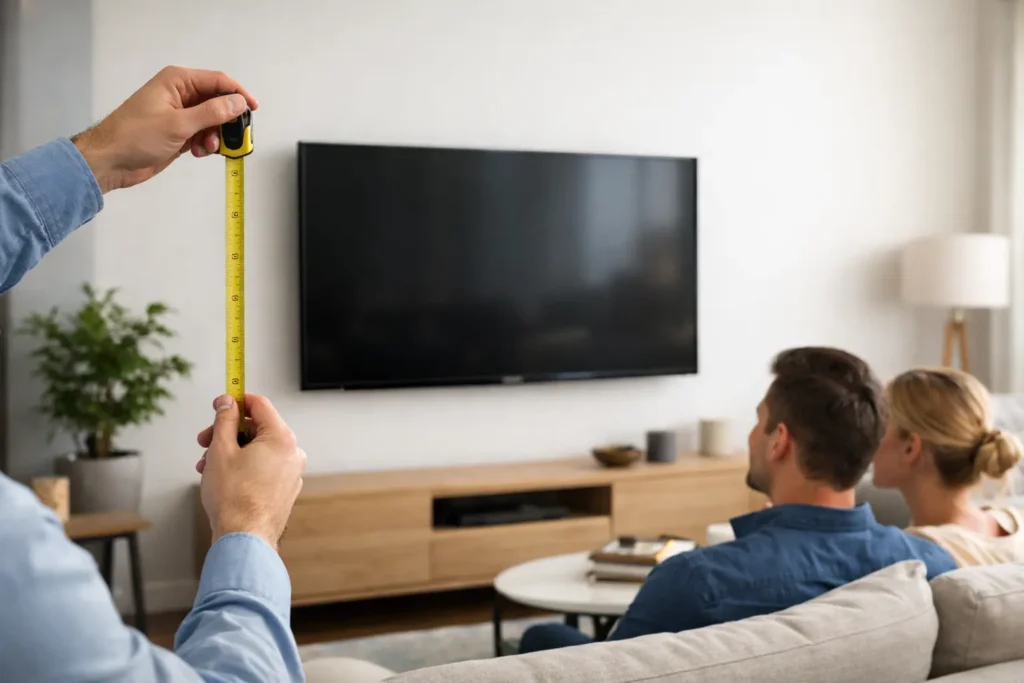
A TV that is only a few inches too high can make a beautiful room feel awkward fast. You notice it in your neck after a movie, in the glare during daytime viewing, and in that nagging sense that the wall looks off. If you are wondering how to choose tv height, the answer is not just “put it at eye level.” It depends on the room, the furniture, the screen size, and how you actually watch.
For most homes, the right height is the one that keeps your eyes naturally centered on the screen without forcing you to look up. That sounds simple, but living rooms are rarely designed around perfect geometry. You may have a fireplace, a low-profile sectional, a bedroom dresser, or windows that limit placement. The goal is to balance comfort, appearance, and practical installation.
How to Choose TV Height for Comfortable Viewing
The best starting point is seated eye level. In a typical living room, most people’s eyes land around 40 to 42 inches from the floor when seated. A good rule is to place the center of the TV as close to that range as possible.
That does not mean every installation should be exactly 42 inches to the center. A larger TV may sit a bit lower at the bottom edge while still keeping the center in a comfortable spot. A room with deeper seating or a reclined viewing position may allow the TV to be a little higher. What matters is where your eyes rest during normal use, not where the wall looks most symmetrical when the room is empty.
If you want a quick way to estimate it, measure the height of your screen and divide it by two. Then subtract that number from your seated eye-level measurement. That gives you a rough bottom-of-TV height.
For example, if your seated eye level is 42 inches and your TV screen height is 27 inches, half the screen is 13.5 inches. That puts the bottom of the visible screen around 28.5 inches from the floor. It is not a hard rule, but it is a strong baseline.
Screen Size Changes the Math
A 55-inch TV and an 85-inch TV do not mount the same way, even in the same room. Bigger screens naturally extend farther above and below the center point. If you mount a very large TV with the bottom edge too high, the top of the screen can end up uncomfortably tall.
This is where many homeowners get tripped up. They may copy a friend’s mounting height without accounting for the difference in screen dimensions. Or they center the TV visually on the wall, which often places it too high for actual viewing.
The larger the screen, the more important it becomes to plan around viewing position first and wall aesthetics second. A big TV mounted correctly often sits lower than people expect. Once the furniture, console, and soundbar are in place, it usually looks right.
Typical Height Ranges That Work
In many living rooms, the center of the TV ends up between 40 and 48 inches from the floor. Bedrooms often run slightly higher because viewers are more reclined. Game rooms or media rooms can vary depending on seating style.
That range is helpful, but it is still just a range. The right number depends on whether you are sitting upright on a sofa, leaning back in a sectional, or watching from a bed. There is no universal mounting height that works in every home.
Viewing Distance Matters Too
Height and distance work together. If you sit very close to a large TV, a high mount feels worse because your eyes have to travel farther upward. If you sit farther back, you can tolerate a little more height without discomfort.
That is why oversized screens in compact rooms need extra care. In many Orange County homes, open-plan living spaces look clean and modern, but they do not always leave ideal wall space. When the seating is closer than expected, even a stylish installation can feel tiring if the TV goes too high.
As a general principle, the closer you sit, the more precise your mounting height should be. If the room has flexible seating, prioritize the primary viewing position, not the occasional seat off to the side.
Fireplace Mounting Is Where Trade-Offs Show Up
One of the most common questions homeowners ask is whether a TV should go above the fireplace. Sometimes the answer is yes. Sometimes it is the only realistic wall. But this is also where comfort often gets sacrificed for layout.
A fireplace usually pushes the TV higher than ideal. If the mantle is tall, the screen can end up well above seated eye level. That may still be acceptable for casual viewing, especially in a formal living room that is not used for long movie nights. For everyday viewing, though, neck strain becomes more likely.
If a fireplace location is the only option, there are ways to reduce the downside. A tilt mount can improve the viewing angle. A mantel-mounted pull-down bracket can bring the screen lower during use. Room design also matters. If your seating reclines, a higher position may feel more natural than it would from upright seating.
The key is being honest about how the room is used. If that TV will be on for sports, movies, and streaming several nights a week, comfort should carry more weight than symmetry above the fireplace.
How to Choose TV Height With a Soundbar or Console
The TV does not live on the wall by itself. A soundbar, media console, electric fireplace insert, or decorative cabinet all affect final placement. Leaving enough space below the TV is important, but too much empty space can make the setup feel disconnected.
Most installations benefit from a balanced gap between the bottom of the TV and the top of the console or soundbar. Often that gap lands somewhere around 4 to 8 inches, depending on equipment size and visual preference. Enough room for airflow, access, and a clean look matters more than hitting an exact number.
This is one reason professional planning helps. The mounting height that looks perfect on paper can change once the center channel speaker, Sonos soundbar, or hidden wiring path is part of the design. A clean finished result depends on the whole system, not just the bracket.
Bedroom TVs Usually Sit Higher
Bedroom viewing is different because your body position is different. When you are lying back on pillows or an adjustable bed, your natural line of sight is higher than it is on a living room sofa. In that setting, a slightly elevated TV often feels better.
That said, there is still a limit. Mounting the TV too close to the ceiling usually looks harsh and feels worse during long viewing sessions. The best bedroom height supports a relaxed viewing angle without forcing you to crane upward.
A simple test helps here. Sit or recline in your normal position and look straight ahead. That line, adjusted slightly upward, is usually a better guide than any standard rule.
Don’t Ignore Glare and Room Light
A perfectly centered TV can still be wrong if sunlight hits it all afternoon. Height affects reflections from windows, glass doors, and overhead lighting. In some rooms, lowering or raising the TV slightly can reduce glare and improve the picture more than expected.
This is one of those practical details that homeowners often notice only after installation. If the screen faces bright natural light, placement should account for both eye level and reflection control. Sometimes a small shift makes a big difference.
Before You Mount, Mock It Up
If you are deciding how to choose tv height, painter’s tape is one of the simplest tools you can use. Mark the outline of the TV on the wall, then sit in your usual spot and live with it for a day or two. Check it in daylight, at night, and from different seats.
This quick step reveals a lot. You may realize the TV feels too high once you settle into the sofa, or too low once the console is in place. It is much easier to adjust tape than patch mounting holes.
If you are installing a large TV, a full mock-up is especially useful. Bigger screens can dominate a wall in ways that are hard to judge from measurements alone.
When Professional Mounting Makes Sense
A good TV height is part comfort decision, part design decision, and part technical decision. Stud location, outlet placement, wire concealment, soundbar spacing, and tilt angle all influence the final result. In many homes, the best viewing height also needs to work with in-wall wiring, clean finishes, and safe mounting.
That is where experience matters. A seasoned installer does not just ask how high you want the TV. They look at seating, room use, equipment, glare, furniture, and what will still feel right six months from now. That is often the difference between a setup that looks okay and one that feels right every time you turn it on.
If you want the simplest rule, start with the center of the screen near seated eye level and adjust based on the room. But if the room includes a fireplace, oversized TV, custom cabinetry, or audio gear, the right answer is usually more tailored than a one-size-fits-all formula.
A well-mounted TV should disappear into the room when you are not using it and feel effortless when you are. That is the sweet spot.
Ready for a free consultation? Let’s get in touch! Call (949) 878-0531 Today