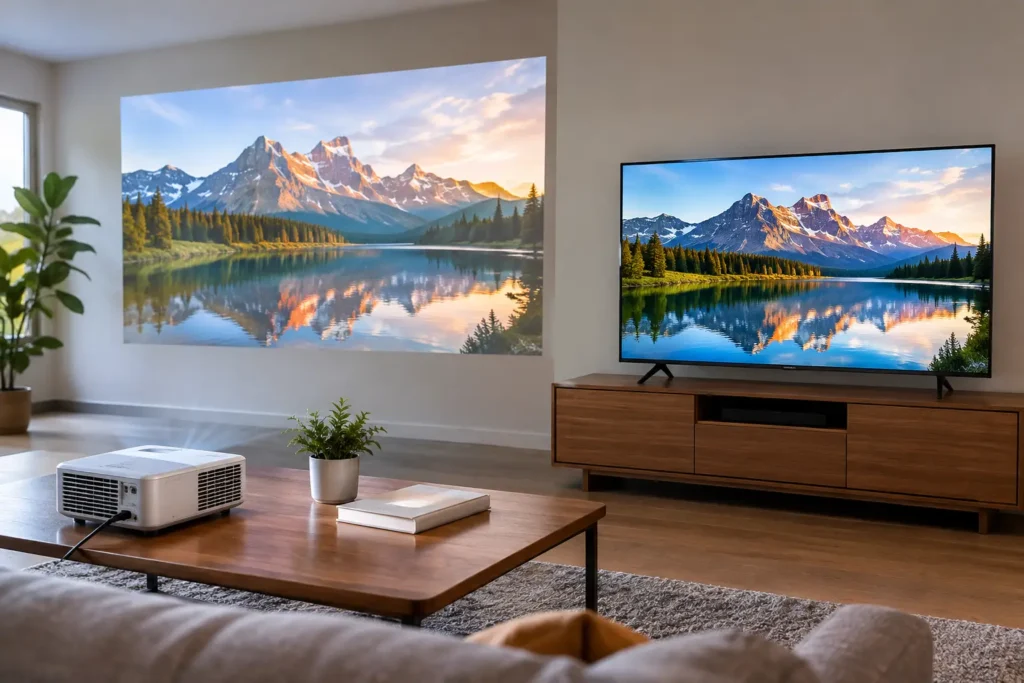
A 98-inch television makes a statement, but it still cannot create the same wall-filling experience as a properly installed 120-inch projector screen. On the other hand, a projector that looks fantastic at night can feel disappointing in a bright great room at noon. The projector vs television decision is less about which display is universally better and more about how you use the room, when you watch, and how much you value a theater-style presentation.
For homeowners planning a media room, living room upgrade, or dedicated theater in Orange County, the right answer often comes down to light control, viewing habits, room layout, and installation details that are easy to overlook before equipment is purchased.
Projector vs Television: Start With the Room
The room should lead the decision, not the screen size listed on a product box. A television is a self-contained display with a bright image, while a projector relies on the projector, screen, viewing surface, ambient light conditions, and placement all working together.
A dedicated theater room is usually an excellent candidate for a projector. If you can close the shades, dim the lights, and position seating at a comfortable distance, a 100- to 120-inch screen can make movies, sports, and gaming feel far more immersive than a standard television. A projector can also disappear when it is not in use, especially with a recessed screen or a ceiling-mounted unit that blends into the room.
A sunny family room has different priorities. Large windows, skylights, white walls, and everyday activity create ambient light that can wash out a projected image. A modern 75-, 85-, or 98-inch television is often the more practical choice in this setting because it stays bright, sharp, and easy to use throughout the day. It also works well for quick viewing, such as checking the news in the morning or putting on a show while cooking dinner.
That does not mean a projector is off the table in a bright room. Motorized blackout shades, an ambient-light-rejecting screen, thoughtful projector placement, and the right model can significantly improve the result. The key is designing the system around the room rather than assuming a projector alone will solve every visual challenge.
Image Size and Viewing Experience
Image size is where projectors make their strongest case. A television can deliver excellent picture quality, but the cost rises quickly as screen size increases. Projectors can produce a 100-inch or larger image for less than many premium extra-large televisions, particularly when comparing the display itself.
For movie nights, major games, and full surround sound systems, that size changes the experience. A properly scaled screen fills more of your field of view without forcing everyone to sit uncomfortably close. It creates a true home theater feel, especially when paired with Dolby Atmos speakers, acoustic planning, and lighting control.
Televisions win on everyday sharpness and punch. Premium LED and OLED displays offer outstanding contrast, deep blacks, vivid color, and excellent detail in a compact package. They are particularly effective for casual daytime viewing, live sports in bright rooms, and video games where low input lag matters.
The best choice also depends on seating distance. An 85-inch television may be ideal for a family room where the main sofa sits eight to 10 feet away. A 120-inch projector screen may be a better fit in a media room with seating 11 to 14 feet from the screen. Going too large can make viewers constantly move their eyes across the image, while going too small can leave a spacious room feeling underused.
Brightness, Black Levels, and Light Control
Brightness is the most common reason homeowners choose a television over a projector. TVs are designed to compete with daylight and room lighting. Even in a bright open-concept living space, a quality television usually maintains a strong, watchable image with little effort from the homeowner.
Projectors need more planning. Their brightness ratings can be misleading because the final image depends on screen size, screen material, wall color, lamp or laser performance, and how much light enters the room. The larger the projected image, the more light is spread across the screen.
Black levels require the same honest assessment. In a dark, controlled theater room, a high-quality projector can produce a beautiful cinematic image. In a bright room, blacks can look gray because the screen reflects ambient light. An OLED television still has the advantage for deep black levels and contrast, particularly in rooms that cannot be darkened.
This is why an in-home assessment matters. A display recommendation should account for windows, ceiling height, paint colors, lighting fixtures, viewing angles, and the time of day the room is used most. A setup that looks impressive in a showroom may not be the setup that performs best in your home.
Installation and Design Considerations
Television installation is generally simpler, but a clean result still takes professional planning. The wall needs proper support, cables need to be concealed, power must be safely located, and the screen should be mounted at a comfortable height. A television placed too high above a fireplace may look dramatic but can become tiring to watch for an entire movie.
Projector installations have more moving parts. The projector needs a secure mount or built-in location, an accurate throw distance, power, video wiring, ventilation, and a screen that is level and correctly sized. Ceiling-mounted projectors also require careful alignment. A small placement error can create a skewed image, poor focus, or visible light spill around the screen.
Short-throw and ultra-short-throw projectors can simplify placement in certain rooms, but they are not automatically the easiest answer. They still need a very flat screen or wall, precise setup, and a compatible screen material to look their best. Furniture placement can also become a concern when the projector sits near the viewing area.
For remodels and new construction, pre-wiring creates more options. Running conduit, HDMI cabling, network connections, speaker wire, and electrical power before walls are finished keeps the installation cleaner and makes later upgrades easier. Tri Star Home Theater often helps homeowners plan these details before a room is furnished, when the best solutions are still accessible.
Cost: Look Beyond the Display Price
Comparing a projector and television by purchase price alone can be misleading. A television package may include the display, wall mount, cable concealment, and sound system integration. A projector system may require the projector, screen, ceiling mount, long-run cabling, power installation, control programming, and possibly window treatments or lighting changes.
At the same time, a projector can be a better value when the goal is a very large image. Buying a 120-inch television is not realistic for most homes or budgets, while a 120-inch projection system is common in dedicated theaters.
Maintenance is another difference. Many newer laser projectors have long operating lives, but projectors may eventually need service, filters, adjustments, or replacement components depending on the model. Televisions require less ongoing attention, although any display can need troubleshooting, firmware updates, or connectivity support over time.
When a Television Is the Better Choice
Choose a television when the room is bright, you want reliable daytime viewing, or the display will be used throughout the day by multiple family members. It is also a strong option when you value the cleanest image quality with minimal setup, have a smaller viewing wall, or want high-performance gaming without managing room lighting.
A television is usually the practical choice for kitchens, bedrooms, offices, patios with appropriate weather-rated equipment, and active family rooms. It turns on quickly, handles casual use well, and integrates easily with streaming devices, soundbars, and whole-home control systems.
When a Projector Is Worth It
Choose a projector when you want a true cinema experience and can give the room the conditions it needs. A dedicated theater, bonus room, basement media room, or a living room with effective shades can all be strong candidates. Projectors are especially compelling for homeowners who prioritize movie nights, playoff games, large-format sports viewing, and a screen size that makes the room feel special.
The most satisfying projector systems are designed as complete environments. The screen, speakers, lighting, control, seating, and wiring all matter. A great projector in front of an unsuitable wall with bright ceiling lights will never deliver the performance it is capable of.
There is also a middle path. Some homes benefit from an everyday television in the main family room and a projector system in a dedicated entertainment space. That approach avoids compromise: the TV handles bright, casual viewing, while the projector creates the big-screen experience when the occasion calls for it.
The better display is the one that fits how your household actually lives. Consider the room at its brightest, the content you watch most, where people sit, and whether you want a convenient daily screen or an event-level theater experience. A thoughtful design upfront prevents expensive compromises after installation.
Ready for a free consultation? Let’s get in touch! Call (949) 878-0531 Today