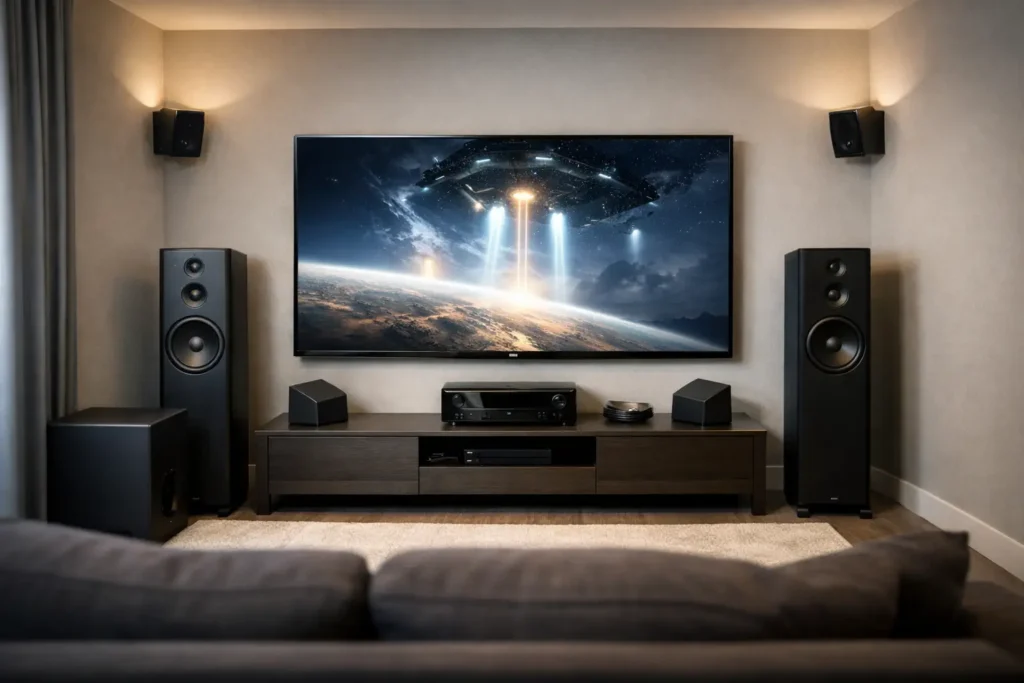
A lot of homeowners start with the same question: can a 5.1 home theater Dolby Atmos setup actually deliver that overhead, theater-style sound, or do you need a bigger and more expensive system to make it worth it? The short answer is that Atmos can sound excellent in a 5.1-based room, but only when the layout, speaker choice, wiring, and calibration are handled correctly. This is one of those projects where small placement mistakes can have a bigger impact than people expect.
For many living rooms, media rooms, and multipurpose family spaces, a 5.1 Atmos system hits the practical sweet spot. It gives you front soundstage coverage, surround effects, a dedicated subwoofer channel, and added height information without requiring a full dedicated theater footprint. The catch is that Dolby Atmos is not just a label on the receiver box. It depends on geometry, room surfaces, seating position, and how the system is installed.
What a 5.1 home theater Dolby Atmos setup really means
A standard 5.1 system includes five ear-level speakers and one subwoofer. That usually means a left, center, and right speaker across the front, two surround speakers to the sides or slightly behind the listening area, and one powered subwoofer handling low frequencies.
When people say Atmos with 5.1, they often mean either a 5.1.2 or 5.1.4 configuration. The first number is your ear-level speakers, the second is the subwoofer, and the third is the number of height channels. In real-world homes, 5.1.2 is the more common upgrade path because it adds two height speakers without turning the room into a major construction project.
That distinction matters because a true Dolby Atmos experience needs height information. If your receiver says Atmos but you are only running five speakers and a subwoofer, you are not hearing the format the way it was designed. The added height layer is what creates the sense of sound moving above and around you.
The best room types for this setup
A 5.1 home theater Dolby Atmos setup works especially well in rooms where people want performance without giving up the room to equipment. That includes open-concept family rooms, bonus rooms, dens, and smaller dedicated theaters.
Ceiling height plays a big role. Flat ceilings around 8 to 10 feet usually perform best, especially if you plan to use in-ceiling speakers or Atmos-enabled upward-firing modules. Vaulted or heavily angled ceilings can still work, but they reduce predictability. With bounce-style Atmos modules, the wrong ceiling shape can weaken the overhead effect enough that the upgrade feels minor.
The seating position also matters more than many buyers realize. If the couch is pushed hard against the back wall, surround placement becomes tricky and the Atmos effect can feel less balanced. In those cases, a custom placement strategy often produces a better result than a standard diagram copied from a product manual.
Choosing between in-ceiling and upward-firing Atmos speakers
If you want the cleanest and most convincing height performance, in-ceiling speakers are usually the better choice. They give you direct overhead sound, they look integrated, and they avoid the limitations of relying on sound reflections. For homeowners who care about aesthetics, this is often the most polished option when the room and ceiling access allow for it.
Upward-firing Atmos modules can still be a solid solution, especially in finished rooms where opening ceilings is not ideal. They sit on top of front or surround speakers and reflect sound off the ceiling toward the listener. When the ceiling is flat, not too high, and reasonably reflective, they can produce a noticeable Atmos effect. But there is no getting around the trade-off – reflected sound is usually less precise than direct overhead speakers.
This is where a lot of systems go wrong. People buy Atmos-enabled speakers because the packaging makes the install look simple, but their ceiling is too high, too angled, or finished with materials that absorb too much sound. The result is a system that technically supports Atmos but does not deliver the impact they expected.
Speaker placement matters more than speaker price
You can spend generously on equipment and still end up with a disappointing room if the layout is off. In a 5.1 Atmos room, placement has to support both surround imaging and clear dialogue.
Your left, center, and right speakers should anchor the screen area, with the center aimed clearly at the main seating position. That center channel is responsible for most dialogue, so hiding it in a cabinet or placing it too low often causes the biggest day-to-day frustration.
Surround speakers should sit to the sides of the main listening area or slightly behind it, typically above ear level but not so high that they start competing with the height layer. The Atmos speakers should be positioned relative to the main seats, not just wherever there is open ceiling space. Good installers think in terms of listening angles, not just room symmetry.
Subwoofer placement is another area where theory and reality often differ. A subwoofer in the wrong corner can create boomy bass in one seat and weak bass in another. Sometimes a room benefits from a front-corner location. Other times, moving the sub just a few feet changes the entire low-end response. This is why calibration and testing matter.
Receiver, wiring, and power considerations
A proper Atmos setup needs an AV receiver that supports the number of channels you plan to run. For a 5.1.2 layout, you need a receiver capable of processing at least seven channels. If there is any chance you may expand later, it can make sense to buy slightly ahead of your current needs.
Wiring decisions should also be made early. In-ceiling speakers require speaker wire runs through the walls or attic, and clean cable management makes a major difference in both appearance and reliability. Finished spaces can often be wired neatly, but the level of difficulty depends on attic access, wall construction, and where equipment is located.
This is also the stage where homeowners should think about source components and streaming habits. A well-designed sound system can still disappoint if the TV settings, streaming box, or HDMI connections are not passing Atmos correctly. Many service calls come down to settings, handshakes, or mismatched equipment rather than bad speakers.
Why calibration is not optional
Even a perfectly placed system needs calibration. The receiver has to balance speaker levels, distances, crossover points, and timing so that sound reaches the listening position the way it should.
Automatic room correction does help, and most modern receivers include some version of it. Still, auto-calibration is not always the last word. It can set crossover points too low, misread a speaker distance, or fail to account for unusual furniture placement. A trained ear and a few manual adjustments often make the system sound more natural and more cinematic.
This is especially true in Southern California homes with large glass surfaces, open living areas, and mixed-use rooms. Hard finishes can brighten a room and open layouts can reduce bass consistency, so the install has to account for the actual environment rather than ideal showroom conditions.
Common mistakes homeowners make
The most common mistake is assuming Atmos is a product, not a system. Buying an Atmos receiver or a soundbar with the logo does not guarantee an immersive result.
Another issue is treating the room as an afterthought. Furniture, ceiling shape, recessed lighting, and viewing distance all affect what is possible. A beautiful room can still support excellent sound, but the design has to be intentional.
People also underestimate the value of clean installation. Exposed wiring, poorly mounted speakers, and equipment crammed into unventilated cabinets create long-term service problems. A good setup should sound right, look right, and remain easy to use every day.
Finally, there is the upgrade trap. Some homeowners try to piece together a system from mixed old and new components that do not quite match in output or tonal character. That can work in some cases, but it depends on the equipment. Compatibility is not just about whether it powers on. It is also about whether the room ends up sounding coherent.
When professional installation makes the biggest difference
If the room is already prewired, a straightforward install may be simple. But when you are adding ceiling speakers, hiding cables, integrating a TV, programming remotes, or solving coverage problems in an open floor plan, experienced installation usually saves time and frustration.
That is especially true for homeowners who want a clean result without trial and error. In areas like Newport Beach, Irvine, and the surrounding Orange County communities, many homes have finish details, built-ins, or architectural features that call for a tailored approach instead of a one-size-fits-all package. A company like Tri Star Home Theater typically looks at the room first, then recommends the layout that fits the space, the listening goals, and the budget.
A good Atmos room does not need to be oversized, and it does not need to feel technical. It just needs the right plan. When the speakers disappear into the room, the dialogue stays clear, and the sound lifts above the screen the way it should, that is when the system starts feeling less like equipment and more like part of the home.