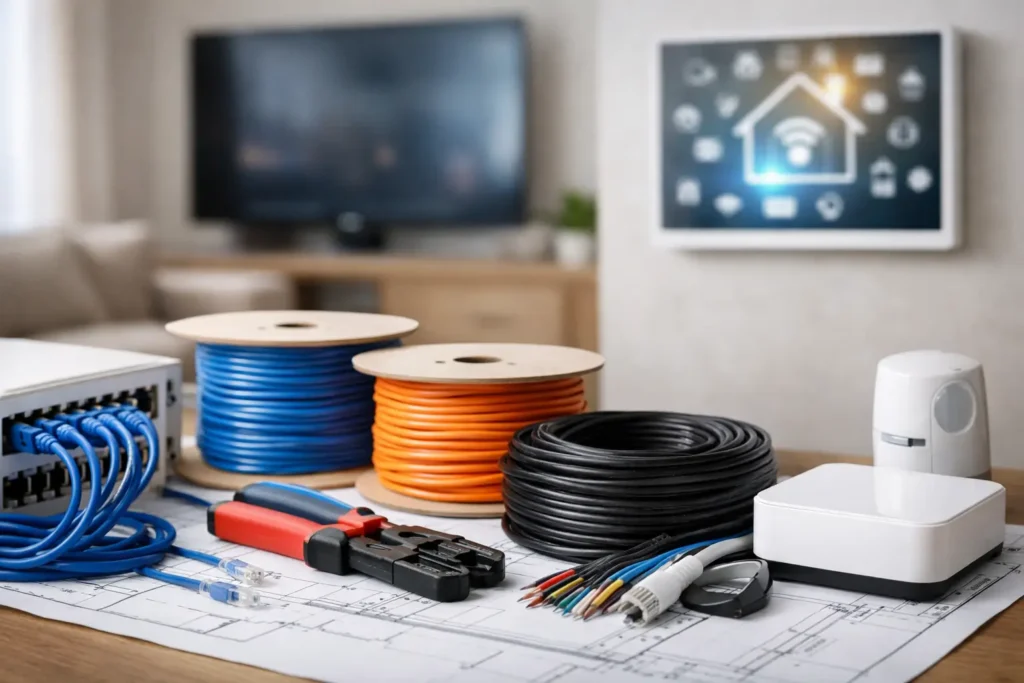
If you have ever opened a media cabinet and found a mess of adapters, splitters, and mystery wires, you already know why a solid low voltage wiring guide matters. The right wiring plan is what makes a home theater feel polished, keeps WiFi more reliable, supports cameras and smart devices, and gives you room to upgrade later without opening walls again.
Low voltage wiring is the backbone behind the parts of a modern home that people use every day but rarely see. It covers the cable runs for TVs, speakers, networking, security cameras, control systems, keypads, touchscreens, and more. When it is planned correctly, the result is simple to live with. When it is rushed or treated like an afterthought, the problems tend to show up fast.
What low voltage wiring actually covers
A good low voltage wiring guide starts with scope. Many homeowners think only about one TV location or a few ceiling speakers, but the real picture is broader. Low voltage systems typically include Ethernet cabling, speaker wire, coax, HDMI over category cable, camera wiring, alarm wiring, control wire, and pre-wire for access points, doorbells, and motorized shades.
In practical terms, this wiring supports the spaces where people spend time. The family room may need a mounted TV, soundbar or surround sound, streaming devices, and a wired network drop. A dedicated theater may need projector wiring, in-wall speakers, subwoofer lines, and control. Outdoor areas may need weather-rated speakers, TVs, and strong WiFi. An office may need reliable hardwired internet and clean video conferencing support.
That is why low voltage planning is less about cables and more about how you want the home to function.
Low voltage wiring guide for new builds and remodels
The best time to wire a house is before drywall. That does not mean you cannot improve an existing home, but pre-wire gives you more options, cleaner finishes, and lower labor costs compared with fishing wires through finished walls.
In a new build or major remodel, it makes sense to think room by room and system by system. Start with entertainment, then networking, then security, then control and future upgrades. Many people focus on what they need today and forget that technology changes faster than walls do. A little extra planning now can save a lot of disruption later.
For example, running one network cable to a TV location may work for a basic setup, but two or more is often smarter. The same goes for speaker wire in living spaces where a soundbar seems fine now, but future surround sound may be appealing later. Even if every wire is not used immediately, having it in place adds flexibility.
Where wiring should go first
The central wiring location is one of the most important choices in the whole plan. This is the structured panel, rack, or media area where network gear, switches, amplifiers, cable boxes, streaming hardware, and control components may live. If that location is cramped, hot, or hard to access, maintenance becomes frustrating very quickly.
From there, priority wiring usually goes to the main TV areas, office spaces, ceiling wireless access point locations, camera positions, doorbells, and audio zones. Bedrooms may need less infrastructure than a media room, but they still benefit from network and TV pre-wire. Patio and backyard spaces are often overlooked until late in the project, and then homeowners realize they want outdoor audio, a weatherproof display, or stronger coverage near the pool or seating area.
This is where an experienced installer earns their keep. The goal is not to over-wire every wall for the sake of it. The goal is to put the right wiring in the right places based on the layout, construction type, and how the property will actually be used.
Choosing the right cable types
Not every cable run should be treated the same. Ethernet is now one of the most valuable low voltage investments in a home because it supports streaming, smart home devices, cameras, access points, and control systems. In most cases, category cable is the workhorse of the entire system.
Speaker wire matters too, especially for in-ceiling, in-wall, surround sound, and outdoor audio. The gauge and rating should match the distance and installation environment. Camera wiring has its own requirements, especially if power and data are being delivered together. Fiber may make sense in select situations, particularly for long runs, detached buildings, or high-performance network needs, but not every home needs it.
One common mistake is mixing budget materials with premium expectations. If the goal is dependable performance, cable quality, termination quality, and installation quality all matter together. A nice TV and high-end speakers will not make up for bad wiring practices hidden behind the walls.
The clean-installation factor
Homeowners usually notice low voltage wiring only when it looks bad or works poorly. That is why clean planning matters just as much as technical planning. Wall-mounted TVs should have properly placed recessed boxes or pathways for concealed cabling. Equipment locations need ventilation and service access. Speaker placements should support balanced sound, not just convenient construction.
A low voltage wiring guide should also account for furniture layout and real-world use. A perfectly wired room can still be inconvenient if the outlets, network jacks, or control points are placed where they are blocked by cabinetry or make no sense for daily living. Good wiring should feel invisible once the system is complete.
This is especially important in homes where design matters. In many Southern California properties, homeowners want performance without visual clutter. That often means hidden wire paths, flush-mounted hardware, carefully placed speakers, and networking gear tucked away in a serviceable but discreet location.
Common mistakes that create expensive headaches
The biggest wiring mistakes are usually not dramatic. They are small planning misses that turn into ongoing annoyances. A TV power outlet may be too high or too low. A projector line may be installed without enough flexibility for future models. A WiFi access point may be placed in the wrong part of the house. Camera pre-wire may miss the angle needed to actually cover an entry point.
Another common issue is underestimating bandwidth and device count. Homes now have smart TVs, phones, tablets, gaming systems, cameras, thermostats, streaming boxes, video doorbells, and automation hardware all competing for network performance. Relying on a basic builder-grade setup often leads to weak coverage and inconsistent speed.
Then there is the repair problem. If wires are unlabeled, poorly terminated, or buried behind inaccessible finishes, even simple service calls take longer than they should. Good installers think about the next technician too, whether that is next month or five years from now.
Should you pre-wire for future tech?
Usually yes, but with some discipline. Future-proofing is useful when it is practical, not when it turns into random cable runs with no plan. A smart approach is to install pathways, conduit in select locations, extra category cable to key rooms, and speaker pre-wire where future audio is realistic.
Conduit can be especially helpful for projector locations, major TV walls, and certain outdoor or hard-to-access zones. It gives you a path to adapt later without opening finished surfaces. That kind of foresight can make upgrades much easier as display standards, control systems, and network demands continue to evolve.
At the same time, not every room needs every possible wire. A thoughtful plan beats an oversized one.
DIY or hire a pro?
Some homeowners are comfortable running a few low voltage lines, especially in open framing. But full-house wiring is rarely just about pulling cable. It involves placement strategy, code awareness, signal integrity, rack planning, trim-out, testing, and making sure the finished system works as a whole.
That is where professional design and installation usually pays off. You are not just hiring someone to put wire in the walls. You are hiring someone to think through the entire experience, from TV mounting and surround sound to network stability, camera coverage, and clean final appearance. For homes in Newport Beach, Irvine, Costa Mesa, Laguna Beach, and nearby Orange County communities, that level of detail often matters as much as the equipment itself.
The best low voltage wiring guide is the one that fits the house, the homeowner, and the way the system will actually be used. If you are planning a remodel, building a theater room, upgrading WiFi, or simply trying to avoid another round of visible cables and patchwork fixes, this is one area where getting it right early makes everything easier later.
Ready for a free consultation? Let’s get in touch! Call (949) 878-0531 Today