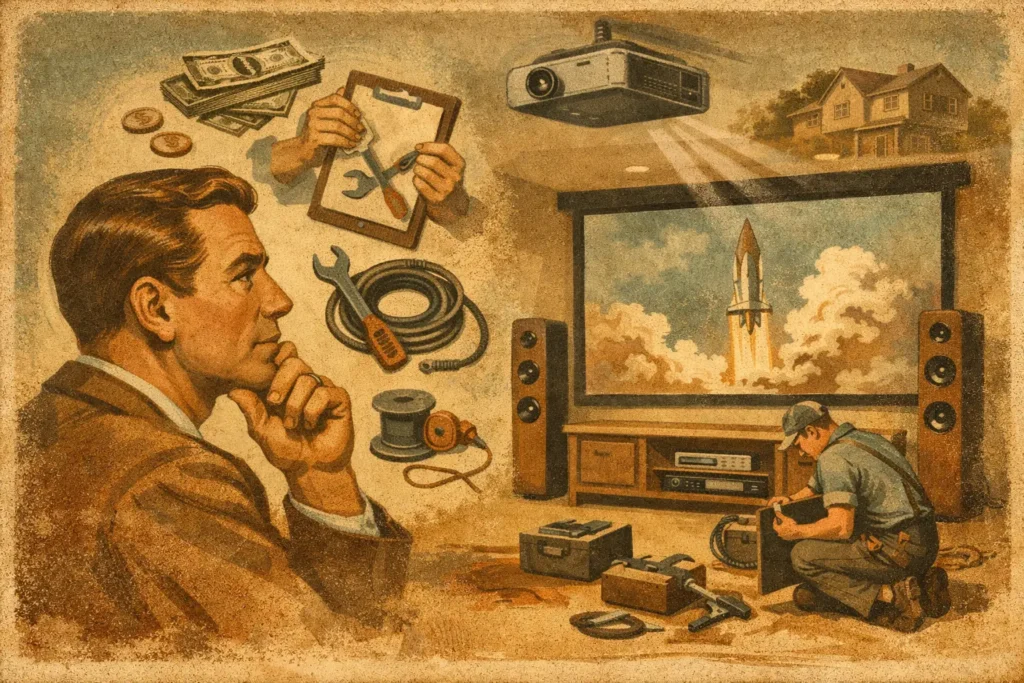
A lot of homeowners start with one simple question – what is a realistic home theater installation cost? The honest answer is that pricing can vary quite a bit, because a basic TV-and-soundbar setup is a very different project from a fully wired media room with surround sound, projector, acoustic upgrades, and smart control.
That variation is exactly why installation estimates can feel confusing at first. Two projects may both be called a “home theater,” but one involves mounting a TV over drywall and hiding a few cables, while another requires in-wall speaker wiring, equipment rack planning, remote programming, WiFi improvements, and finish work that has to look clean in a high-end living space. If you understand what actually drives the cost, it becomes much easier to budget wisely.
Home theater installation cost starts with the room
The room itself has a major impact on labor, materials, and design choices. An open family room is usually less expensive to outfit than a dedicated theater room, but it can present its own challenges with speaker placement, sunlight, and viewing angles. Dedicated rooms often cost more because they invite more complexity – larger sound systems, projector placement, screen installation, acoustic treatment, and more detailed wiring.
Room size matters, but layout matters just as much. A smaller room with easy attic access may be simpler than a larger room with concrete walls, limited access, or a finished ceiling that makes wire runs harder. Homes with tall ceilings, custom millwork, fireplaces, or delicate wall finishes can also increase labor time because the installation has to be both technically correct and visually clean.
In Southern California homes, aesthetics are often just as important as performance. Clean cable concealment, discreet speaker placement, and equipment hidden out of sight usually take more planning than a straightforward exposed setup. That adds value, but it also adds labor.
Equipment choice changes the price fast
One of the biggest reasons home theater pricing varies is that the equipment itself can range from modest to premium very quickly. A basic setup may include a TV, a soundbar, and streaming devices. A more advanced system might include an AV receiver, in-wall or in-ceiling speakers, subwoofers, a projector, screen, universal remote, and smart home integration.
The more pieces involved, the more installation and calibration work is required. Mounting a single display is one task. Integrating multiple source devices, tuning speaker levels, programming control systems, and making sure everything works reliably together is another level of service.
There is also a trade-off between convenience and customization. All-in-one systems cost less to install and are often a good fit for casual viewing spaces. A component-based theater costs more upfront, but it usually provides better sound, greater flexibility, and easier upgrading later. Neither option is automatically right or wrong. It depends on how you use the room and what matters most to you.
Typical system tiers homeowners consider
Most projects fall into one of three general categories. A starter media-room setup may focus on TV mounting, a soundbar, hidden wires, and streaming setup. A mid-range theater often adds surround sound, an AV receiver, subwoofer, and more involved cable routing. A premium installation may include Dolby Atmos speakers, projector and screen installation, acoustic considerations, smart control, and rack-based equipment management.
That is why one homeowner may spend a relatively modest amount on installation, while another is investing in a full entertainment environment.
Wiring, pre-wiring, and wall conditions matter more than most people expect
If there is one part of home theater installation cost that surprises people, it is usually the labor behind wiring. Running HDMI, speaker wire, network cable, control wire, and power in finished spaces can be straightforward or very time-consuming depending on access.
New construction and remodels are usually the best-case scenario because walls are open and wiring can be planned properly from the start. Retrofits in finished homes are more complicated. Installers may need to work around insulation, fire blocks, tile, stone, cabinetry, or limited crawlspace and attic access. Even a simple speaker run can take time when the path is tight and the goal is to leave no visible trace.
Wall type also matters. Standard drywall is one thing. Brick, concrete, stone, or specialty finishes often require different methods, more labor, and extra care. If the project includes cutting and patching, repainting, or custom concealment solutions, cost will increase accordingly.
Audio setup is where complexity often shows up
A lot of people think the screen is the centerpiece of a home theater, but from an installation standpoint, audio is often where the project becomes more technical. A soundbar install is relatively simple. A true surround system with front, center, rear, subwoofer, and overhead Atmos channels requires thoughtful placement, wire routing, receiver setup, and calibration.
This is also where room behavior matters. Hard surfaces, open floor plans, and unusual seating layouts can affect sound quality. A professional installer is not just connecting speakers. They are making sure voices are clear, surround effects are balanced, bass is controlled, and the system performs the way it should in that specific room.
Better sound usually means more equipment, more wiring, and more setup time. It also means a much bigger difference in everyday use. That is one area where cutting corners often leads to disappointment.
Control systems, networking, and streaming can add hidden labor
Modern theaters rely on more than display and sound. They also depend on strong connectivity and simple control. If your WiFi struggles, your streaming devices buffer, or your remote setup is confusing, even expensive equipment can feel frustrating.
That is why some installations include network upgrades, hardwired connections, remote programming, and smart home integration. These items are not always part of the first budget people imagine, but they can make a major difference in how dependable the system feels day to day.
For example, adding a universal remote or app-based control may sound minor, but proper programming takes time. The same goes for integrating TVs, receivers, streaming boxes, projectors, motorized screens, and lighting control into one user-friendly experience.
Labor rates reflect expertise, not just time on site
When comparing estimates, it is tempting to focus only on the bottom-line number. But installation pricing is not just about hours worked. It reflects planning, troubleshooting ability, finish quality, equipment knowledge, and whether the company can solve problems if something unexpected comes up.
A lower quote may leave out calibration, cleanup, cable concealment, smart control setup, or post-install support. It may also come from a general handyman rather than a dedicated AV specialist. Sometimes that works out fine for a simple TV mount. Sometimes it becomes more expensive later when the system needs to be redone, repaired, or expanded.
An experienced installer typically costs more than a bargain option, but you are paying for cleaner execution and fewer headaches. For many homeowners, especially in finished living spaces, that is money well spent.
How to budget your home theater installation cost wisely
The best approach is to build the project around how you actually use the space. If the room is mainly for family movie nights and everyday streaming, you may not need a full dedicated theater package. If you care about immersive sound, sports viewing, entertaining, or a polished media room that feels custom to the house, it makes sense to invest in the wiring and infrastructure that support that experience.
It also helps to separate must-haves from nice-to-haves. Clean mounting, hidden wires, strong sound, and dependable connectivity are often the foundation. Extras like advanced automation, premium acoustic treatments, or whole-home integration can sometimes be phased in later.
That is often the smartest path. Install the backbone correctly the first time, especially wiring and equipment placement, then upgrade components as your needs change.
When a complimentary estimate is especially helpful
A site visit becomes valuable when the room has fireplace mounting, over-garage spaces, tall ceilings, existing but outdated wiring, or a mix of old and new equipment. Those are the situations where online price guesses tend to miss the real scope of work.
For homeowners in Newport Beach, Irvine, Costa Mesa, Laguna Beach, and nearby areas, local conditions can matter too. Custom homes, remodels, coastal properties, and design-sensitive interiors often require a more tailored approach. That is where a company like Tri Star Home Theater can usually give the clearest pricing guidance – not by forcing a package, but by looking at the room, the goals, and the practical details that affect labor.
What you are really paying for
Home theater installation cost is not just the price of putting equipment in a room. You are paying for system design, technical skill, proper mounting, safe and clean wiring, performance tuning, and a finished result that feels easy to use. The best installations almost disappear into the home – everything looks right, sounds right, and works without constant tinkering.
If you are budgeting for a project, focus less on finding the cheapest number and more on getting a system that fits the room, the home, and the way you live. A well-planned theater does more than fill a wall with electronics. It turns everyday viewing into something people actually look forward to using.
Ready for free consultation? Let’s get in touch! Call (949) 878-0531 Today