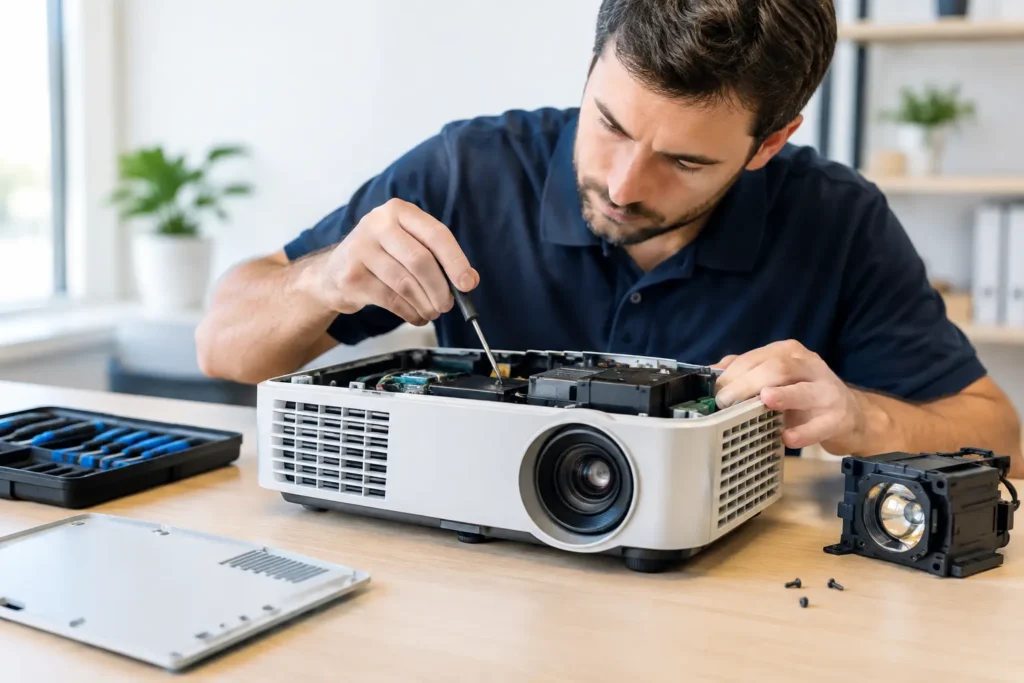
A projector can look perfectly fine until movie night starts: the image flickers, colors shift, the screen goes dark, or the system refuses to find a signal. When that happens, projector repair service reviews can help narrow the field, but a five-star average alone does not tell you whether a technician can diagnose the issue correctly in your home.
For homeowners, the best repair experience is rarely about the fastest appointment or the lowest quoted service call. It is about finding someone who understands the projector, screen, receiver, streaming devices, cabling, and room conditions as one connected system. That distinction matters when a problem that appears to be a failed projector is actually an HDMI issue, a control setting, a weak WiFi connection, or an aging component elsewhere in the AV chain.
What Projector Repair Service Reviews Should Tell You
Useful reviews describe the work, not just the result. A comment such as “great service” is encouraging, but it offers little insight into whether the company can troubleshoot an intermittent picture problem or complete a clean ceiling-mounted repair. Look for customers who explain what went wrong, how the technician approached it, and whether the solution held up after the visit.
The strongest reviews often mention clear communication. Projector problems can have several possible causes, and a good technician should explain what is known, what still needs testing, and what repair options make financial sense. Homeowners should not be pressured into replacing equipment before the source of the problem has been identified.
Pay attention to comments about punctuality, care inside the home, and follow-through as well. A projector repair may require access to ceiling mounts, equipment racks, attic wiring, screens, and receivers. That work calls for more than technical knowledge. It requires a technician who protects the space, works neatly, and makes sure the full system operates before leaving.
Read Beyond the Star Rating
A perfect rating from a handful of generic reviews is not necessarily more meaningful than a slightly lower rating supported by detailed feedback over time. The pattern matters. Are customers consistently mentioning knowledgeable troubleshooting, fair recommendations, responsive scheduling, and clean workmanship? Those details are more valuable than a score by itself.
Recent reviews deserve extra attention because AV technology changes quickly. A service provider may have years of experience with traditional lamp projectors but limited familiarity with laser models, 4K signal paths, HDR settings, eARC connections, or modern control systems. Experience is essential, but it should be relevant to the equipment and symptoms in your home.
It also helps to separate reviews for installation from reviews for repair. An installer may be excellent at mounting a projector and running cable, yet repair work demands a different kind of diagnostic discipline. Ideally, you want a local AV specialist who handles both. That person can assess the original installation, isolate the fault, and recommend an upgrade only when it is genuinely the better value.
Signs a Review Describes Real Diagnostic Skill
Projector issues are often misdiagnosed because the visible symptom is not the root cause. No image, for example, may point to a failing lamp or laser engine, but it can also result from an HDMI handshake failure, a damaged cable, an incorrect receiver output, a source-device setting, or a power issue at the mount.
Reviews that mention testing multiple components are especially useful. A qualified technician should verify the projector’s operation, inspect the signal path, test source devices, check the receiver or switcher, and confirm the selected resolution and refresh rate. For a system that works only sometimes, this process may take more care than a simple part replacement.
Color and brightness complaints require similar judgment. A dim picture may be caused by an aging lamp, accumulated dust, optical wear, incorrect picture settings, or a room that has become brighter after a remodel. Replacing a lamp may be sensible on one projector and a poor investment on another. Reviews that describe honest recommendations can reveal whether a company is willing to discuss that trade-off.
Repairs That May Be Worth It
Many common projector problems can be corrected without replacing the entire system. A lamp replacement, filter cleaning, cable repair, mount adjustment, input configuration, remote programming issue, or receiver setting may be relatively straightforward when handled properly.
Repair is often worthwhile when the projector is otherwise performing well, replacement parts are available, and the system still supports the image quality and connections you need. It can also be the practical choice when a projector is integrated into a custom ceiling installation and the homeowner wants to avoid changing the mount, wiring, or screen setup.
When Replacement Is the Better Call
There are times when a repair estimate should lead to a broader conversation. If the optical block, laser light source, main board, or internal imaging components have failed, repair costs can approach the price of a newer projector. Older models may also lack the brightness, 4K capability, HDR performance, or HDMI compatibility needed for current streaming devices and AV receivers.
That does not mean replacement is automatically the answer. A well-installed projector can last for years, and newer equipment may require adjustments to the mount, throw distance, screen, ventilation, or control system. The right provider should explain both paths clearly rather than treating a replacement sale as the only solution.
Questions to Ask Before Booking a Visit
Reviews help you create a short list. A quick phone conversation should confirm whether the company is prepared for your specific situation. Ask whether they diagnose complete projector systems, not only the projector itself. Explain the model, the symptoms, when the issue occurs, and whether any receiver, soundbar, control remote, or streaming device is involved.
You can also ask how the service call is handled if the problem requires a part or if the projector needs manufacturer-level repair. Some issues can be resolved in the home, while others may require a specialized shop or replacement decision. Clear expectations are far better than a vague promise that everything can be fixed on the first visit.
For ceiling-mounted projectors, ask about safe access and mount inspection. A loose mount, strained cable, blocked ventilation path, or misaligned lens can affect both performance and safety. This is particularly relevant in dedicated theater rooms, bonus rooms, and outdoor entertainment areas where equipment may be harder to reach.
Why Local, Full-System Service Makes a Difference
Home theater equipment is not used in isolation. A projector depends on the quality of the incoming signal, the condition of the cables, the receiver configuration, the screen position, room lighting, and often the home’s network. A technician focused only on one device may solve part of the problem while leaving the frustrating part behind.
For homeowners in Newport Beach and across Orange County, a local specialist can offer practical advantages: on-site troubleshooting, familiarity with residential installations, and a direct point of contact when the issue involves more than one component. Tri Star Home Theater approaches repairs with that full-system perspective, whether the solution is a targeted correction, a component upgrade, or a better way to simplify control of the room.
The best projector repair service reviews do not merely say that a technician was nice or arrived on time. They show that the customer was listened to, the system was tested carefully, the choices were explained honestly, and the room was left ready to enjoy again.
A good repair decision should restore confidence in the whole experience, not just bring an image back to the screen.
Ready for a free consultation? Let’s get in touch! Call (949) 878-0531 Today