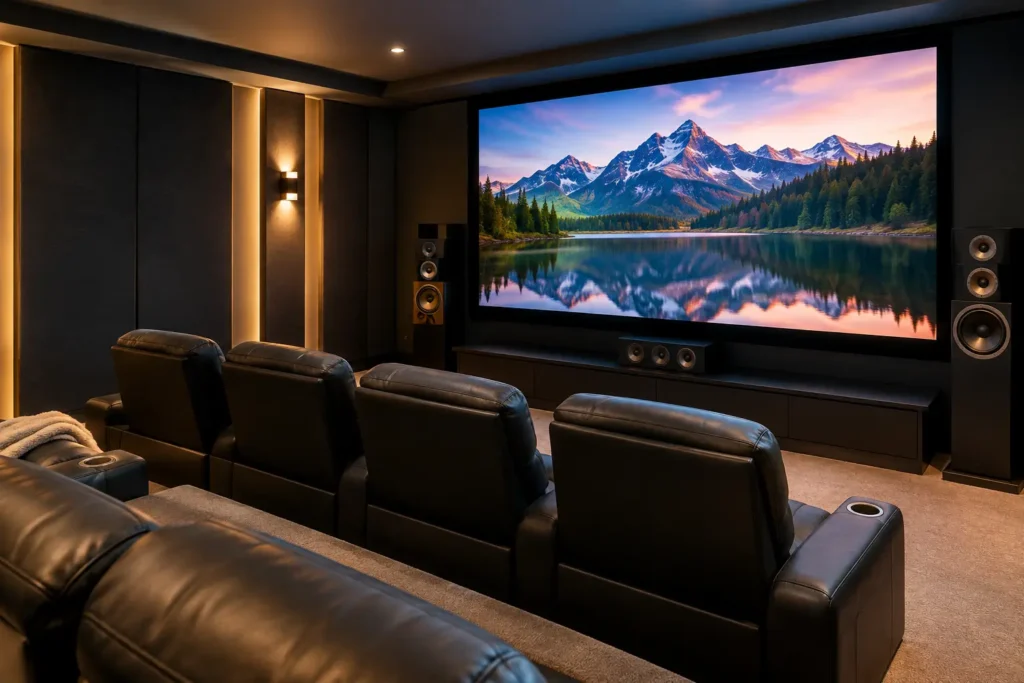
A beautiful television and expensive speakers can still produce a disappointing experience if the room, wiring, controls, and placement are treated as afterthoughts. The best home theaters feel easy from the first movie night: clear dialogue, immersive sound, a bright and balanced picture, and no visible tangle of cables competing with the room’s design.
For homeowners planning a remodel, furnishing a new space, or upgrading an older system, the goal is not simply to buy more equipment. It is to build an entertainment space that works reliably for the way your household actually watches, listens, and lives.
Start With the Room, Not the Equipment
A dedicated theater room gives you the most control over sound and light, but it is not the only route to a great result. A family room, bonus room, den, or covered outdoor space can become an excellent media area when the system is designed around its real conditions.
Light is often the first consideration. A projector can create a wonderfully large image, particularly in a room with controlled lighting. In a bright living room with large windows, however, a high-quality TV may provide a more consistent daytime picture. Blackout shades, screen selection, wall color, and the direction of windows all affect the decision.
Room shape matters as well. Hard surfaces such as tile, glass, and stone are common in Orange County homes and look fantastic, but they can make sound feel bright or echoey. Area rugs, upholstered furniture, acoustic treatments, and careful speaker calibration can make dialogue easier to understand without changing the character of the room.
The right setup should also respect sightlines. A screen mounted too high may look clean on a wall but can become uncomfortable during a long movie. Seating distance, TV size, fireplace placement, and the height of the primary viewer’s eyes should all be considered before anything is mounted.
Sound Is What Makes a Theater Feel Like a Theater
Most people notice picture quality first. Over time, they usually appreciate sound quality even more. Clear dialogue means less reaching for the remote. A properly placed subwoofer adds impact without rattling the entire house. Surround speakers make sporting events, concerts, and movies feel more involving, not merely louder.
A soundbar can be a practical choice for a clean living room or a secondary TV. Modern models can offer wide sound and simple streaming, especially when paired with a subwoofer. But a soundbar has limits. If you want convincing surround effects, stronger dialogue separation, and performance across several seats, separate speakers and an AV receiver generally provide more flexibility.
Dolby Atmos Needs More Than Ceiling Speakers
Dolby Atmos adds a vertical layer to sound, allowing effects such as rain, aircraft, and music to move above the listener. It can be impressive, but it is not automatically the right upgrade for every room.
Ceiling speakers need to be placed around the seating area, not installed wherever construction is easiest. Their position, the ceiling height, and the main seating location all influence the result. In some finished rooms, upward-firing Atmos speakers may be a reasonable alternative, though they depend on a suitable flat ceiling and do not create the same level of precision.
Speaker count is another common source of confusion. A well-designed 5.1 system can outperform a poorly installed 7.1 or Atmos system. Good placement, correct calibration, and equipment matched to the room matter more than chasing a channel count on a box.
Plan Wiring Before the Walls Close
Pre-wiring is one of the most valuable steps in a new build or renovation. It gives you options that are difficult and more costly to add later: in-wall speaker wire, network cable, conduit for future upgrades, security camera wiring, and dedicated locations for TVs, projectors, access points, and equipment racks.
Even in a finished home, clean cable concealment is often possible. The method depends on wall construction, fireplace materials, electrical access, and the location of the equipment. A professional installer should evaluate the wall rather than promise a one-size-fits-all solution. Some installations need in-wall routing, while others are better served by paintable raceways or a nearby cabinet that keeps components out of view.
Avoid assuming that one HDMI cable solves every future need. Video standards change, and long cable runs have particular demands. Conduit creates an accessible pathway for replacement cables later. For projector installations, this small planning detail can prevent a major headache when equipment is upgraded.
Reliable WiFi Is Part of the System
Streaming has made network performance central to home entertainment. A 4K movie buffering during a busy evening is rarely a TV problem. It may be weak WiFi coverage, a poorly placed router, network congestion, or an outdated access point.
Whenever possible, stationary equipment such as a TV, streaming device, receiver, or game console benefits from a wired network connection. Wired connections are stable and free up WiFi capacity for phones, tablets, and smart-home devices. When wiring is not practical, a properly planned mesh WiFi system can improve coverage across larger homes and outdoor entertainment areas.
This is also why equipment placement deserves attention. Storing networking gear and AV components in a tightly enclosed cabinet without ventilation can create heat and performance problems. A clean installation should still allow equipment to breathe and make service access practical.
Controls Should Be Simple Enough for Everyone
A theater is only enjoyable if everyone in the home can use it. Too many systems require several remotes, the correct input selection, and a memorized sequence of buttons just to start a show. That complexity turns good equipment into a source of frustration.
A properly programmed universal remote or smart-home control system can bring the TV, receiver, streaming device, lighting, shades, and audio zones into a single routine. Pressing one button can turn on the right components, select the preferred source, and set the room for viewing.
There is a trade-off here. A simple remote is often the best choice for a single-room theater. A larger smart-home platform makes more sense when you want control across several rooms, outdoor audio, lighting scenes, or security features. The best solution is the one your family will continue to use comfortably, not the one with the longest feature list.
Design for Daily Use, Not Just Movie Night
Theaters are often planned around blockbuster movies, but most systems spend more time playing TV shows, sports, music, and games. Think about the whole week. Do you want music in the kitchen and patio? Is low-volume late-night listening important? Will children use the space independently? Do you need a system that switches easily between a game console, cable box, and streaming apps?
For homes with open floor plans, multi-room audio can be more valuable than a fully enclosed theater. For a dedicated media room, better acoustics and a projector may take priority. For a living room with a large fireplace, a carefully mounted TV, discreet speakers, and concealed wiring may deliver the biggest improvement without changing the room’s style.
A local specialist can help weigh those choices before equipment is purchased. Tri Star Home Theater designs and supports systems with the full picture in mind, including installation, calibration, repairs, upgrades, and the practical details that determine whether the finished system feels polished.
When an Existing System Needs Help
You do not always need to replace everything. Many older home theaters can be improved through targeted repairs or upgrades. Common issues include a receiver that no longer supports modern video formats, speakers that are wired incorrectly, a projector with a dim lamp or failing component, intermittent HDMI connections, poor remote programming, or WiFi that cannot keep up with current streaming demands.
A troubleshooting visit can identify what is worth keeping and what has become the weak link. That approach is often more cost-effective than replacing equipment that is still performing well. It also prevents a new component from being installed into an older system without addressing the connection, power, network, or control issue behind the problem.
The right home theater should disappear into your routine. You should notice the movie, the game, or the music – not the cables, settings, and technical work required to make it happen.
Ready for a free consultation? Let’s get in touch! Call (949) 878-0531 Today