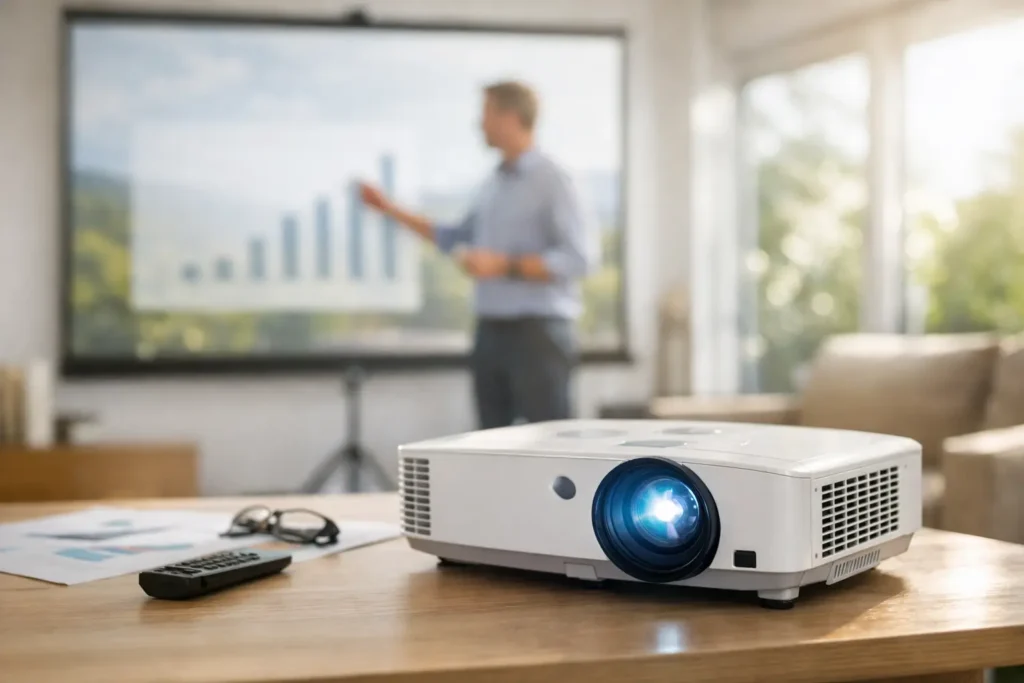
A projector can create a spectacular movie-night image, then look washed out at noon when sunlight fills the same room. So, can projector work in daylight? Yes, but only when the projector, screen, room lighting, and seating layout are designed to work together. Brightness alone helps, but it cannot fully overcome direct sun on a screen.
For homeowners who want a large image for sports, casual TV, gaming, and movies, the goal is usually not a pitch-black theater during the day. It is a picture that remains bright, clear, and comfortable to watch without turning the room into a cave. That is realistic with the right equipment and a thoughtful installation.
Can a Projector Work in Daylight Without a Dark Room?
A projector works by sending light onto a screen. Daylight also sends light onto that screen, which lifts the black level and reduces contrast. Dark scenes lose depth first. Shadows become gray, colors appear less saturated, and fine detail can disappear long before the image becomes completely unwatchable.
The result depends on where the light is coming from. A room with shaded windows behind the seating area is much easier to manage than a room where afternoon sun hits the screen directly. Even an expensive projector will struggle if sunlight falls across the viewing surface. In that situation, window treatment and screen placement matter as much as the projector itself.
A daytime-capable projection system is often a good fit for a multipurpose family room, media room, covered patio, or dedicated theater with controlled lighting. It may be less practical for an open living room with floor-to-ceiling glass and no way to block direct light. In some bright rooms, a large television is the better everyday choice, while a projector remains ideal for evening movies and special events.
Brightness Is the Starting Point, Not the Whole Answer
Projector brightness is measured in ANSI lumens. As a general planning range, a 100-inch screen in a controlled room may look excellent with roughly 2,000 to 3,000 ANSI lumens. A room used during the day with moderate ambient light may need 3,000 lumens or more, depending on screen size and lighting conditions.
More lumens do not automatically mean a better picture. Some high-brightness projectors achieve their brightest setting by sacrificing color accuracy, and their fans may run louder at maximum output. A projector that looks great on a spec sheet can still produce a disappointing image if it is paired with the wrong screen or installed in an overly bright location.
Screen size also changes the equation. A projector’s light output is spread across the entire image. If you increase the image from 100 inches to 135 inches, the picture becomes noticeably dimmer because the same light is covering a larger area. Clients often want the largest possible screen, but a slightly smaller screen can deliver a more satisfying daytime image.
Watch the Specs Carefully
Marketing terms can make projector comparisons confusing. Look for ANSI lumens from a reputable manufacturer rather than vague claims about LED lumens, peak lumens, or light-source brightness. A laser light source can be an excellent choice because it maintains strong brightness over time and offers quick startup, but laser technology by itself does not solve ambient-light problems.
Native resolution, contrast performance, color handling, and lens quality still matter. For sports and streaming, a bright, well-calibrated 4K projector can make a large image feel lively even with some lights on. For movies with dark cinematography, room control becomes more critical.
The Right Screen Makes a Major Difference
A quality screen is not just a white surface on the wall. Its material, gain, texture, and color determine how it reflects the projector’s light and how it handles light already in the room.
A standard matte-white screen is often the best choice in a dedicated theater because it provides a wide viewing angle and natural color. In a brighter room, however, an ambient-light-rejecting, or ALR, screen may be the smarter investment. These screens are designed to reject light arriving from certain directions while reflecting more of the projector’s light back toward viewers.
For a ceiling-mounted standard projector, the ideal ALR screen must match the projector’s placement. For an ultra-short-throw projector that sits just below the screen, a different screen material is required. Using the wrong ALR screen can create hot spots, uneven brightness, or a dull image.
Screen gain is another factor. A higher-gain screen reflects more light toward the seating area and can make an image appear brighter. The trade-off is a narrower viewing angle and, in some cases, visible brightness variation. For a wide family seating arrangement, balance is usually better than chasing the highest possible gain.
Control the Light Before You Buy More Equipment
The most cost-effective way to improve daytime projection is often reducing uncontrolled light. Motorized shades, blackout drapes, solar shades, and well-placed window coverings can transform a room without requiring an extreme projector upgrade.
Direct sunlight should never land on the screen. If the room layout allows it, position the screen on a wall that does not face the brightest windows. Recessed lights and pendant fixtures should also be planned carefully. Lights in front of the screen are more damaging to contrast than lights behind the audience or along the sides of the room.
Wall and ceiling colors matter more than many homeowners expect. White walls, glossy finishes, and light-colored ceilings reflect light back onto the screen, weakening contrast. A dedicated theater benefits from darker, matte finishes near the screen, while a shared living space may simply need sensible lighting zones and dimmable fixtures.
Projector Placement Affects Daytime Performance
Correct mounting height, distance, lens alignment, and image geometry protect picture quality. Digital keystone correction can make a crooked image look rectangular, but it reduces usable resolution and should not be the primary solution. A properly planned ceiling mount or rear shelf installation lets the projector use its optics as intended.
Ultra-short-throw projectors are appealing in bright multipurpose rooms because they can sit close to the wall and avoid a long ceiling-mounted throw path. They reduce the chance of someone walking through the beam, and they can pair well with specialized ALR screens. Still, they need a perfectly flat screen and careful setup. A slight screen ripple or misalignment is much more visible with an ultra-short-throw model.
Traditional long-throw projectors offer more placement flexibility and often provide stronger home-theater performance for the price. The right choice depends on the room, the desired image size, and whether the system is primarily for daytime TV or cinematic viewing after dark.
A Practical Daytime Setup for Orange County Homes
Many homes in Newport Beach, Irvine, and surrounding Orange County communities have beautiful natural light, expansive windows, and open floor plans. Those features are excellent for daily living, but they require a more deliberate approach to projection.
A successful setup may include a bright laser projector, a 100- to 120-inch screen sized appropriately for the room, light-rejecting screen material, and motorized shades programmed into the remote or smart-home system. With one button press, the screen lowers, shades close, lights dim, the receiver turns on, and the correct streaming input appears. The system should feel simple for everyone in the home, not like a technical project each time you want to watch a game.
For outdoor entertainment, a projector can work well after sunset or in a deeply shaded covered area. Daytime outdoor projection is far more demanding because reflected light and changing sun angles are difficult to control. An outdoor-rated TV is frequently the more reliable solution for full-day visibility, while a projector creates the bigger event-style experience at night.
When a TV Is the Better Answer
There is no benefit in forcing a projector into a room that cannot support it. If the space receives strong daylight all day, has no practical shade solution, and will be used mainly for news, sports, and casual television, a large TV may offer better brightness, contrast, and convenience.
A hybrid approach can work especially well: a large TV for daily viewing and a projector with a retractable screen for movie nights. The best recommendation comes from seeing the room, understanding how the family uses it, and designing around real conditions rather than a showroom demo.
A projector can absolutely work in daylight, but the best results come from managing the room rather than asking one component to overcome every challenge. A well-designed system lets you enjoy the scale of projection when it makes sense and gives you a picture that still feels polished when the sun is up.
Ready for a free consultation? Let’s get in touch! Call (949) 878-0531 Today