A TV mounted above a fireplace can look clean and high-end, but the built-in speakers are usually firing sound down or backward into the wall. That is where the soundbar vs ceiling speakers decision becomes more than an equipment question. It affects how clearly you hear dialogue, how your room looks, and whether the system works for movie night, music, or both.
For many Orange County homeowners, the right answer is not simply one or the other. Soundbars and ceiling speakers serve different jobs. Understanding those jobs before wiring walls or mounting a TV can prevent a costly setup that looks great but does not sound the way you hoped.
Soundbar vs Ceiling Speakers: The Main Difference
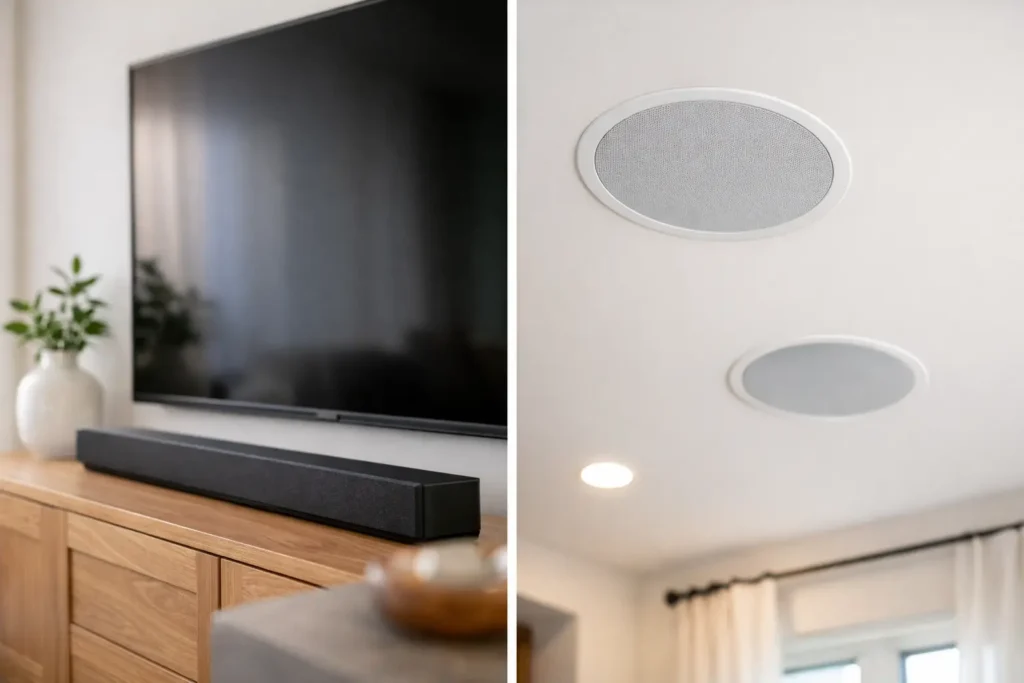
A soundbar is designed to be the primary front sound source for a television. It sits below or near the screen, so dialogue, music, and effects seem to come from the action you are watching. Many models also include separate wireless subwoofers, rear speakers, or Dolby Atmos processing for a larger surround experience.
Ceiling speakers are typically installed overhead and used for distributed music, surround channels, or whole-home audio. They disappear into the ceiling and can cover a room evenly, which makes them an excellent fit for kitchens, patios, living areas, and open-concept homes.
The distinction matters because voices in a movie should generally come from the screen, not from directly over your seating area. Ceiling speakers can play TV audio, but using them alone as the main TV speakers often creates a less natural experience. You may hear sound clearly, yet it can feel detached from the picture.
When a Soundbar Is the Better Choice
A soundbar is usually the practical choice when TV and movies are the priority. It improves dialogue clarity immediately, takes up very little space, and can be installed without turning the room into a full theater project.
This makes soundbars especially effective in bedrooms, casual family rooms, condos, and spaces where the TV is the main entertainment source. A well-chosen soundbar can also be a smart option for a fireplace-mounted television, provided it is positioned correctly and the wiring is concealed cleanly.
Better dialogue and screen-focused sound
The center channel is one of the biggest reasons to choose a soundbar. In a movie or sporting event, it carries much of the dialogue and on-screen action. Quality soundbars are built to keep voices anchored near the display rather than sending them overhead.
For homeowners who regularly ask for clearer speech without raising the volume to uncomfortable levels, a soundbar with a dedicated center channel is often a worthwhile upgrade. This is particularly useful in open rooms with hard surfaces such as tile, glass, and stone, where sound can bounce around.
A simpler installation path
Soundbars can be a strong fit when you want meaningful improvement with less construction. The installation may involve mounting the bar, running hidden power and HDMI connections, configuring eARC, and programming one remote to control everything properly.
The simple part is relative. A soundbar can still look messy or perform poorly if it is mounted too high, blocked by a TV stand, connected through the wrong TV port, or set to the wrong audio format. Professional setup helps ensure the equipment is working at its full capability rather than functioning as an expensive external speaker.
Great for compact rooms, with limitations
Soundbars are not a replacement for every kind of speaker system. They can create convincing width and virtual surround sound, but a compact bar cannot always match the depth, output, and placement flexibility of separate speakers.
If you have a large media room, high ceilings, or want theater-level impact, a soundbar may be the starting point rather than the final answer. Adding a subwoofer and rear speakers can help, but room layout still matters.
When Ceiling Speakers Make More Sense
Ceiling speakers are the better choice when you value clean architecture and music throughout the home. With properly planned placement, they provide even coverage without visible speaker cabinets, cords, or furniture taken up by equipment.
They are especially popular in remodeled homes where pre-wiring is possible before drywall is closed. In an existing home, they can still be installed cleanly after a careful assessment of ceiling access, joists, lighting, insulation, and wiring paths.
Whole-home music without visual clutter
For background music while cooking, entertaining, or relaxing outdoors, ceiling speakers are difficult to beat. They can be grouped by room, controlled from an app or smart home system, and paired with systems such as Sonos for flexible listening.
A kitchen and adjacent great room, for example, may benefit from multiple ceiling speaker pairs because people move throughout the space. A single soundbar at the TV would not provide the same balanced coverage away from the screen.
Useful as part of a surround sound system
Ceiling speakers are also valuable in a properly designed surround or Dolby Atmos system. They can be used for height effects, bringing rain, aircraft, ambient music, and other effects above the listener. In certain rooms, in-ceiling speakers may also be used for rear surround channels when wall placement is not practical.
That does not mean every ceiling speaker layout creates Dolby Atmos. Speaker position, listening distance, receiver compatibility, and calibration all affect the result. A system needs to be designed around the room, not just around where there is an open spot in the ceiling.
The TV-audio compromise
Using ceiling speakers alone for television sound can work in a secondary viewing area, but it has compromises. Dialogue tends to sound as if it is coming from above you. Depending on the ceiling height and speaker location, the result can be less direct and less cinematic than a soundbar or front speaker setup.
Ceiling speakers also require an amplifier or receiver and speaker wiring. That creates more installation work than a typical soundbar, although it can be the better long-term investment for a home built around whole-home audio.
The Best Option for Many Homes: Use Both
The most satisfying answer is often a hybrid system. A soundbar or dedicated front speakers handle TV, movies, and dialogue at the main display. Ceiling speakers provide music in the room and surrounding spaces. When planned correctly, both systems can be easy to operate without competing with each other.
For example, a living room may have a soundbar below the TV for everyday viewing, two ceiling speakers for music, and a subwoofer tucked out of sight. A dedicated theater could use front speakers around the screen, in-ceiling Atmos channels, and separate surround speakers for a more immersive layout.
The key is control. Homeowners should not need three remotes or a confusing series of inputs just to watch a streaming show. A professional installation can tie the equipment together with reliable control, properly labeled connections, and settings that make sense for daily use.
What to Consider Before Installing Either Option
Start with how you actually use the room. If most evenings involve TV shows, movies, and sports, prioritize sound from the screen. If the room is primarily used for entertaining and casual music, ceiling speakers may deserve more of the budget.
Also consider ceiling height, seating position, room size, construction access, and future plans. A soundbar is easy to upgrade later, while ceiling speaker wiring is best planned before a remodel is finished. If you expect to add a projector, surround sound, smart home control, or outdoor audio, it is often more cost-effective to design the wiring infrastructure once.
Aesthetic preferences count too. Some homeowners want equipment completely hidden. Others want the strongest possible theater performance. There is no wrong preference, but the design should be honest about what each option can and cannot deliver.
For a family room that needs clear TV audio and discreet music, the best system may be a carefully installed combination rather than a forced choice. Tri Star Home Theater can assess the room, recommend equipment that matches your goals, and make sure the finished installation looks as polished as it sounds.
Ready for a free consultation? Let’s get in touch! Call (949) 878-0531 Today