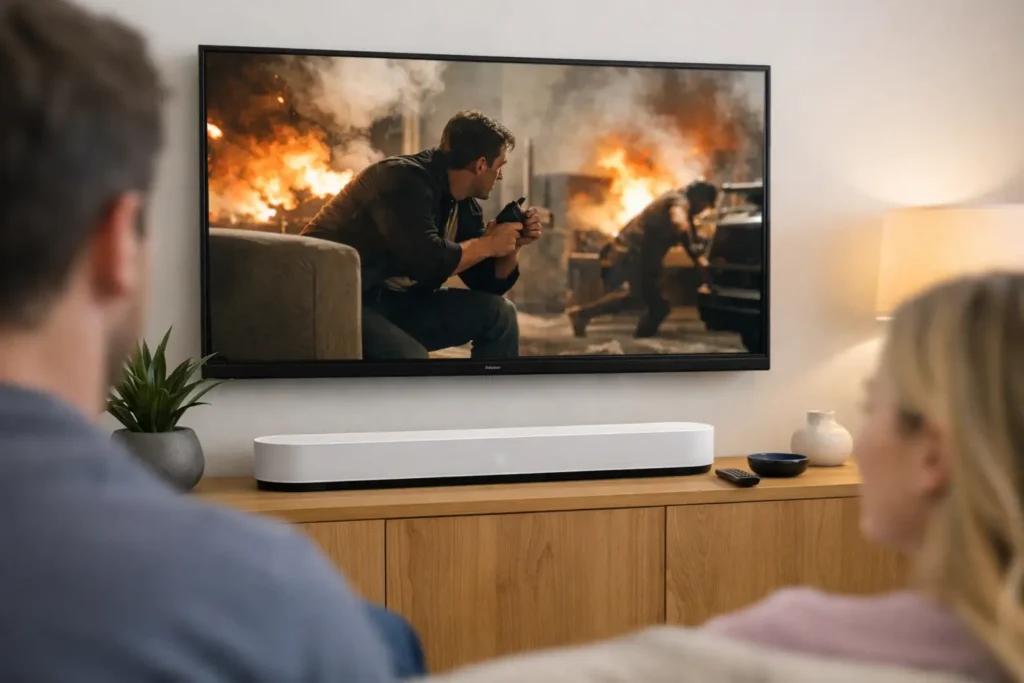
A new TV can look incredible and still sound thin. Modern flat panels leave very little room for capable built-in speakers, which is why many homeowners ask, is Sonos good for TV? For the right room and expectations, it can be an excellent answer: clean-looking equipment, simple daily operation, and a noticeable improvement in dialogue, music, and movie sound without filling the room with traditional AV gear.
Sonos is not automatically the best choice for every television setup, however. The right recommendation depends on room size, seating layout, the type of content you watch, your WiFi reliability, and whether you want an easy soundbar system or a true surround-sound theater. Here is the practical way to think about it.
Is Sonos Good for TV in a Typical Living Room?
Yes. Sonos is particularly strong for living rooms, family rooms, bedrooms, and media spaces where appearance and convenience matter as much as performance. A Sonos soundbar sits neatly below a wall-mounted TV, connects through HDMI, and can usually be controlled with the TV remote. That is a major benefit for households that do not want a complicated stack of components or multiple remotes.
The biggest immediate improvement is usually clearer dialogue. News programs, sports broadcasts, and streaming shows often have quiet voices mixed against music or sound effects. A properly placed soundbar gives voices more presence than TV speakers can provide. Sonos also offers speech enhancement settings and night listening options that can be useful when others are sleeping nearby.
For many homes in Newport Beach, Irvine, Costa Mesa, and surrounding Orange County communities, that combination is exactly the goal: better sound, a clean installation, and an entertainment system that guests and family members can use without a lesson before movie night.
Where Sonos Sounds Its Best
Sonos has several soundbar options, and the right one should match the TV and room rather than simply the largest available budget. A compact soundbar can be a sensible fit for a bedroom, smaller den, or secondary TV. Larger soundbars are better suited to open-concept great rooms and larger screens, where they can create a broader soundstage and deliver more convincing movie effects.
A single soundbar improves TV audio substantially, but adding a wireless subwoofer changes the experience. Bass is not only about feeling explosions. A quality subwoofer adds weight to music, impact to action scenes, and warmth to everyday programming. It also lets the soundbar focus more effectively on midrange and high-frequency detail, including voices.
Rear surround speakers are the next meaningful upgrade. When placed behind or slightly beside the main seating area, they provide true surround effects rather than simulated sound coming only from the front wall. With compatible equipment and content, a Sonos system can also deliver Dolby Atmos effects that add a sense of height and movement to the soundtrack.
The best results still depend on the room. Vaulted ceilings, large expanses of glass, hard floors, and open floor plans can make sound less predictable. Sonos room tuning can help, but it cannot completely overcome a challenging layout. Proper speaker placement and setup remain important.
The TV Connection Matters More Than Most People Expect
For a dependable Sonos TV setup, use the TV’s HDMI ARC or eARC port whenever possible. This connection allows the television to send audio back to the soundbar and lets the TV remote control volume through HDMI-CEC. It is cleaner and generally more capable than an optical connection.
An eARC-equipped TV is especially helpful if you want the best chance of receiving higher-quality Dolby Atmos audio from compatible streaming devices and content. ARC can still work very well for many systems, but the exact audio formats available depend on the TV, the source device, and how everything is connected.
This is where an installation can become more involved than it appears. A cable box, Apple TV, game console, Blu-ray player, and receiver may all handle formats differently. If a homeowner hears lip-sync delay, loses sound after switching inputs, or cannot get Atmos to appear, the cause is often a TV setting or connection path, not a defective soundbar.
The Trade-Offs to Know Before Buying Sonos
Sonos earns its popularity through convenience, but convenience comes with limits. It is best to understand those limits before choosing a system.
First, Sonos is a wireless ecosystem, not a no-wires system. The soundbar still needs power and an HDMI connection to the TV. Surround speakers and a subwoofer also need nearby power outlets. During a clean wall-mounted installation, planning outlet locations and concealing low-voltage wiring makes a significant difference in the finished look.
Second, Sonos relies heavily on a stable home network. The TV soundbar connection itself is usually through HDMI, but the wider system, app control, music streaming, surround pairing, and software updates depend on WiFi. Homes with weak coverage, network equipment tucked into a garage, or crowded wireless conditions may need a WiFi upgrade before the system performs as it should.
Third, Sonos is not as flexible as a conventional AV receiver-based theater. If you want several HDMI inputs routed through the audio system, large floor-standing speakers, specialized amplifiers, or a custom 7.1.4 Dolby Atmos layout, a receiver and wired speakers may be the better long-term solution. Sonos is designed around a simpler, more contained approach.
Finally, soundbars cannot fully duplicate the scale of a properly designed dedicated theater. A premium Sonos package can be impressive in a multipurpose room, but it will not replace a carefully positioned system with separate front speakers, a center channel, multiple subwoofers, and room-specific calibration. That is not a flaw. It is simply the difference between an elegant lifestyle system and a purpose-built theater.
Choosing the Right Sonos Setup for Your Room
The best Sonos system starts with how the room is actually used. For casual TV viewing in a bedroom or smaller space, a compact soundbar may be enough. In a standard living room, a more capable soundbar with a subwoofer is often the sweet spot. For a family room where movies, sports, gaming, and entertaining all matter, adding rear speakers can create a much more immersive experience.
Do not choose based on TV size alone. A 75-inch TV in a small enclosed room has very different needs than the same television in a large open living area connected to a kitchen. Seating distance, ceiling height, wall materials, furniture placement, and nearby neighbors all affect what will feel balanced.
It is also worth considering future expansion. A homeowner may begin with a soundbar and later add a subwoofer or surround speakers. Sonos makes that progression straightforward when the original system is selected and installed with expansion in mind. Planning power, speaker locations, and network coverage early avoids unnecessary repairs to walls or visible cords later.
When a Sonos Soundbar Is Not the Best Answer
Sonos may not be the best fit if your main priority is the most cinematic performance possible in a dedicated theater room. It can also be less suitable if you have unreliable WiFi, need extensive hardwired source switching, or want to use speaker brands and components from different audio ecosystems.
In those situations, a traditional surround receiver, wired speakers, and professional calibration can offer more control and greater performance potential. The system may take more planning, but it can be the better investment for serious movie enthusiasts and large dedicated media rooms.
Professional Setup Makes a Noticeable Difference
Even a simple soundbar benefits from careful installation. The soundbar should be centered with the screen, placed at an appropriate height, and not blocked by the TV, cabinet edge, or decorative objects. A wall-mounted TV may require a soundbar mount that moves with the screen, especially when using a full-motion TV mount.
The setup should also include proper HDMI configuration, sound output settings, app setup, room tuning where available, and a real-world test with streaming, cable, and any connected devices. These details are often what separate an impressive system from one that intermittently loses audio or never sounds quite right.
Tri Star Home Theater helps homeowners design and install Sonos systems that fit the room, the TV, and the way the household actually watches. The goal is not to sell more equipment than you need. It is to create sound that is easy to enjoy every day and looks like it belongs in your home.
A good TV audio system should disappear into the routine: press play, hear the dialogue clearly, feel the soundtrack when it matters, and leave the technical troubleshooting behind.
Ready for a free consultation? Let’s get in touch! Call (949) 878-0531 Today