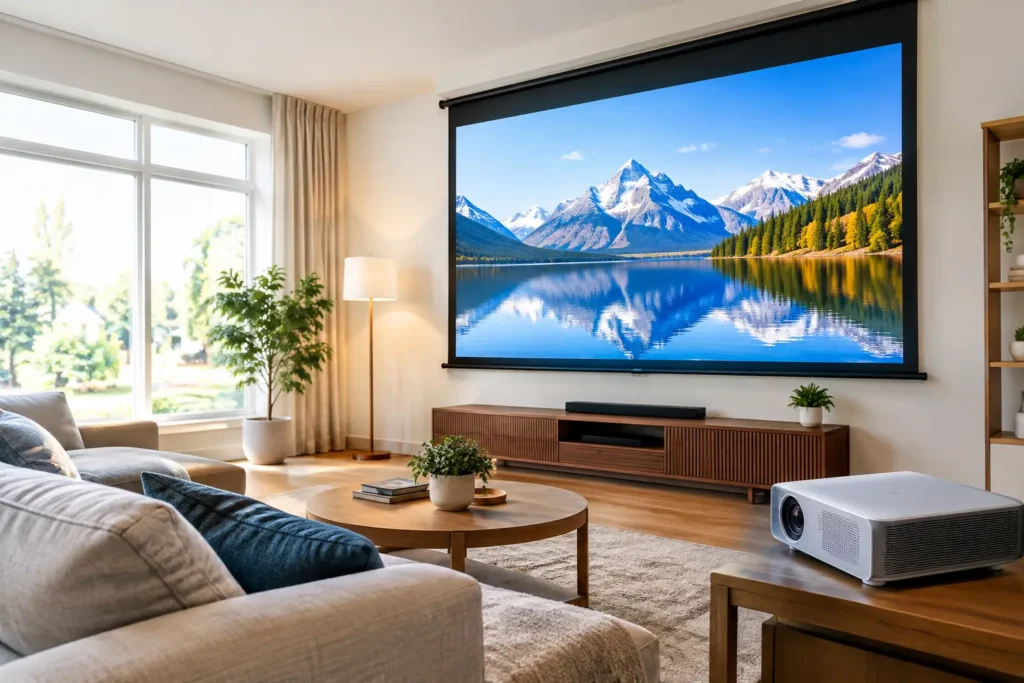
A projector can look spectacular after sunset, then lose its punch the moment morning light reaches the room. That is why finding the best projector screens for bright rooms is less about buying the most expensive screen and more about matching the screen material, projector, layout, and light control to the way you actually use the space.
For many Orange County homes, a projector is not limited to a closed theater room. It may be part of a living room with large windows, a media room that opens to a patio, or a bonus room used by the whole family during the day. In those settings, the right screen can preserve contrast and color while a standard matte-white screen may look washed out.
Why Bright Rooms Challenge Projectors
Projectors create an image by reflecting light off the screen. Ambient light from windows, recessed fixtures, lamps, and skylights also lands on that screen. Unlike a TV, which produces its own contrast at the panel, a projector cannot make black areas darker than the light already falling on the screen.
This is why brightness ratings alone do not solve the problem. A high-lumen projector helps, especially for sports and casual daytime viewing, but it can also make dark scenes look gray if the screen reflects room light back toward the seating area. A better result comes from treating the projector and screen as one system.
The goal is not necessarily to make a sunny living room perform exactly like a dedicated dark theater. That is rarely realistic. The goal is a picture with enough brightness, contrast, and uniformity to be enjoyable at the times you plan to watch it.
The Best Projector Screens for Bright Rooms Use ALR Material
Ambient light-rejecting, or ALR, screens are usually the strongest choice for rooms with uncontrolled or partially controlled light. Their surface is engineered to favor light coming from the projector while rejecting light that arrives from other directions. When properly matched to the projector and room, an ALR screen can make daytime TV, sports, and streaming look noticeably richer.
ALR is not one universal product category. The best material depends heavily on where the projector sits and where unwanted light enters the room.
Standard-Throw ALR Screens
A standard-throw projector is typically ceiling-mounted or placed behind the seating area, sending light toward the screen at a downward angle. Standard-throw ALR materials are designed for that geometry. They can help reduce the impact of side light and overhead light, making them a practical choice for a bright multipurpose room.
These screens work best when the projector is installed in the exact position recommended for the screen material. A screen that rejects light from above may also reject some of the projector’s image if the mounting angle is wrong. This is a detail that often gets missed in do-it-yourself installations.
Ceiling Light-Rejecting Screens
If recessed lights or pendant fixtures are the biggest issue, a ceiling light-rejecting material may be the better fit. These materials are shaped to reflect projected light toward viewers while limiting light from overhead.
They are especially useful in open-concept homes where it is difficult to turn off every light without making the rest of the room impractical. Still, dimming zones near the screen is worthwhile. Even a premium screen performs better when it does not have to fight direct light.
UST ALR Screens
Ultra-short-throw, or UST, projectors sit inches from the wall or screen on a low cabinet. They require a different kind of ALR screen, often called a lenticular or UST ALR screen. Its structure is built to accept light coming upward from below and reject light from above.
A standard ALR screen should not be paired with a UST projector, and a UST ALR screen should not be paired with a ceiling-mounted projector. They may look similar at first glance, but their optical design is fundamentally different. Matching these components correctly is essential.
Screen Gain, Color, and Viewing Angle Matter
Screen gain describes how much light a screen reflects back toward the audience compared with a neutral reference surface. A gain near 1.0 is often the most balanced option. Higher-gain screens can appear brighter, but they may narrow the useful viewing angle or create hot spotting, where the center of the image looks brighter than the edges.
For family rooms with several seats spread across a sectional, a wide viewing angle is usually more valuable than maximum gain. Everyone should see a consistent image, not just the person sitting in the center.
Screen color also involves a trade-off. A gray or darker ALR material can improve perceived black levels and contrast in ambient light, but it requires enough projector brightness to keep whites from looking dull. A white screen generally offers more overall brightness, but it can reveal the room’s stray light more easily. The right choice depends on projector output, screen size, and how much light is present during viewing.
Choose Screen Size Based on Light, Not Just Wall Space
A larger screen is appealing, but it spreads the projector’s light across a bigger surface. In a bright room, going too large can make the image look weak during daytime use. A slightly smaller screen with adequate brightness often delivers a more satisfying picture than an oversized screen that only looks great after dark.
Consider the primary use of the system. A 120-inch screen may be excellent for nighttime movies in a controlled media room. For daytime sports in a bright living area, a 100-inch or 110-inch screen may provide a stronger image with the same projector.
Screen height matters, too. If the screen is mounted too high, viewers may strain their necks and light from windows or fixtures may hit more of the screen directly. Proper placement should account for seating height, sightlines, speaker locations, furniture, and any mantel or built-in cabinetry.
Control the Light You Can Control
An ALR screen is a major improvement, not a substitute for thoughtful room design. The best installations reduce the brightest sources of ambient light before asking the screen to manage the rest.
Start by looking for direct light on the screen. Window coverings, solar shades, blackout drapes, and motorized treatments can make a dramatic difference, particularly when sunlight falls across the image. Dimmable recessed lights and separate lighting zones let the room remain functional without flooding the screen with glare.
Wall and ceiling finishes also play a role. Very light walls near the screen reflect projector light back into the room, reducing perceived contrast. Darker, matte finishes around the front of a dedicated theater room help considerably. In a living room, you may not want dark walls, but avoiding glossy finishes near the screen still helps.
Fixed Frame, Motorized, or Retractable Screen?
For the best image quality, a fixed-frame screen is usually the top choice. Its material stays perfectly tensioned, which prevents ripples and creates a clean, border-like frame around the image. It is ideal for a dedicated theater or media room where the screen can remain visible.
A motorized screen makes more sense when the room serves multiple purposes. It can lower in front of a TV, artwork, windows, or built-ins, then disappear when not in use. For bright rooms, choose a tensioned motorized model whenever possible. Non-tensioned retractable screens can develop waves over time, which become more noticeable with 4K content.
If the screen needs to drop in front of a large window, plan carefully. The screen may improve the picture while it is down, but intense sunlight behind it can still affect performance and may create visible light leakage around the edges. Proper shades or window treatments remain part of the solution.
Do Not Shop for a Screen Separately From the Projector
The most common mistake is selecting a projector first, then treating the screen as an accessory. A quality screen may have as much effect on daytime performance as a projector upgrade. It should be selected after considering throw distance, mounting position, room brightness, viewing angles, desired image size, and the content you watch most.
This is particularly true with laser projectors and ultra-short-throw models. Their brightness and optics can produce excellent results, but only when paired with a compatible screen and installed precisely. A few inches of projector placement or a slight screen alignment issue can affect focus, geometry, and image uniformity.
A professional site evaluation helps avoid costly mismatches. Tri Star Home Theater designs projector and screen systems around the room itself, including screen material, projector placement, cable concealment, lighting considerations, and clean integration with audio and control systems.
The best bright-room projector setup is the one that fits your actual habits: Saturday afternoon games with the shades partly open, family movie nights after dark, or a polished media space that looks as good when the system is off as it does when the screen comes down. Ready for a free consultation? Let’s get in touch! Call (949) 878-0531 Today