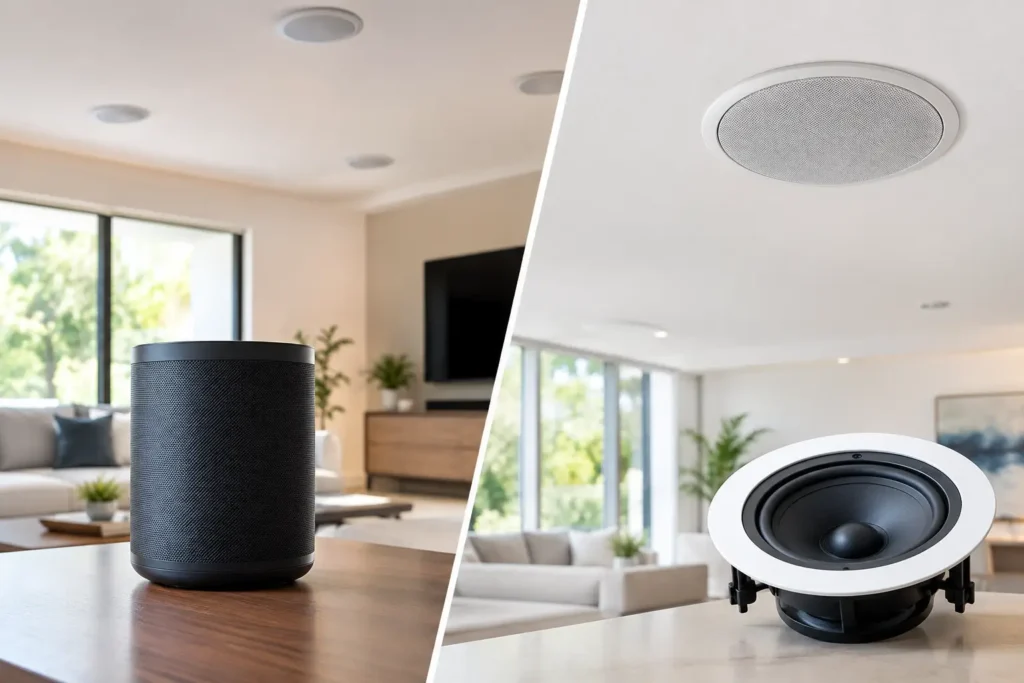
A clean ceiling with music that follows you from the kitchen to the patio is a great upgrade. But the choice between Sonos vs traditional ceiling speakers is not as simple as picking the better speaker. It comes down to how you listen, how many rooms you want to cover, what equipment you already own, and whether the system needs to grow with your home.
For many Orange County homeowners, the right answer is a carefully designed mix. Sonos can make whole-home audio remarkably convenient, while a traditional speaker system can deliver more control, higher performance, and better integration with a dedicated theater. The best setup is the one that sounds good, looks clean, and remains easy for everyone in the house to use.
Sonos vs Traditional Ceiling Speakers: The Core Difference
Traditional in-ceiling speakers are passive speakers. They need power from an amplifier, receiver, or distributed-audio system. The speakers themselves may be installed in the ceiling, but the equipment that drives them is typically stored in an AV cabinet, media room, or structured wiring area.
Sonos is primarily an audio ecosystem built around app control, wireless streaming, grouping rooms, and simple everyday operation. Sonos also offers architectural ceiling speakers designed to work with a Sonos Amp. These are still passive speakers, but the Sonos Amp supplies the power and adds the familiar Sonos control experience.
That distinction matters. This is not always a choice between a “wireless Sonos speaker” and a “wired ceiling speaker.” A Sonos architectural system uses speaker wire in the walls and ceiling, just like a traditional installation. The difference is in the amplification, control platform, music services, and future expansion options.
Where Sonos Ceiling Audio Shines
Easy whole-home music control
Sonos is a strong fit for homeowners who want to open one app, choose a playlist, and send music to the kitchen, family room, primary bedroom, patio, or other listening zones. Family members can control their own rooms, group spaces together for entertaining, or adjust volume without learning how to operate a receiver.
For homes that rely heavily on streaming services, this convenience is hard to overlook. Sonos supports common music sources and lets users move audio around the home without changing inputs or dealing with multiple remotes. It is particularly useful in kitchens, casual living areas, bedrooms, and outdoor entertaining spaces where fast, simple control matters more than audiophile-level tuning.
A clean installation without visible equipment
A Sonos Amp can be placed in a cabinet or AV rack while the architectural speakers disappear into the ceiling. The result is a polished look that works well in remodeled homes, open-concept living areas, and rooms where freestanding speakers would feel out of place.
This approach also makes sense when a homeowner wants to add music to one or two rooms without installing a large central audio system. A properly planned Sonos Amp and speaker pair can be an efficient, dependable solution.
Straightforward expansion
Adding a new Sonos zone is usually easier than expanding an older multi-room audio system. A new room may need another amp, speakers, and proper wiring, but it can join the existing Sonos ecosystem without requiring a complicated matrix controller or a separate source component.
That flexibility is valuable when a project is phased over time. A homeowner might begin with ceiling speakers in the kitchen and patio, then add the primary suite or outdoor lounge later.
When Traditional Ceiling Speakers Make More Sense
Better options for high-performance sound
Traditional speaker systems give you a much wider selection of speaker brands, sizes, driver designs, and amplifier choices. That matters in larger rooms, high ceilings, acoustically challenging spaces, or homes where music quality is a top priority.
A properly designed traditional system can use larger in-ceiling speakers, dedicated subwoofers, separate amplification, and precise tuning. It can also support multiple speakers in a room without being limited by the capabilities of a single compact streaming amp. For a serious listening room or a large great room, those design choices can make a noticeable difference.
Stronger integration with a home theater
If ceiling speakers are part of a surround-sound or Dolby Atmos system, a traditional AV receiver or separate processor and amplifiers are often the better path. The receiver can manage movie soundtracks, surround channels, height speakers, gaming consoles, cable boxes, and streaming devices in one coordinated system.
Sonos has capable home theater products, especially for soundbar-based rooms. However, a traditional receiver-based theater generally offers more flexibility for speaker placement, channel count, calibration, and upgrades. This is especially true for a dedicated theater, a high-end media room, or any project using multiple in-wall and in-ceiling speakers.
More flexibility with sources and controls
A traditional distributed-audio system can be designed around many source types: televisions, turntables, media servers, cable boxes, outdoor TVs, and streaming devices. It can also be paired with professional control systems, keypads, handheld remotes, or a smart-home platform.
This is useful for homeowners who want the TV audio from the family room available in the patio, kitchen, or adjacent entertaining areas. With thoughtful system design, one source can be shared where it makes sense while each zone can still play its own music when needed.
Sound Quality Is About Design, Not Just the Brand
It is easy to assume traditional speakers always sound better or that Sonos is automatically easier. Neither statement is universally true. Speaker location, ceiling height, room dimensions, insulation, furniture, amplifier power, and installation quality all affect the final result.
For example, a well-installed pair of Sonos architectural speakers driven by the right amp can sound excellent in a kitchen or dining room. On the other hand, premium traditional speakers will not perform as intended if they are placed too far apart, installed in the wrong ceiling area, or driven by inadequate equipment.
In an open-concept home, the goal should be even coverage rather than simply using the fewest speakers possible. Two speakers may be enough for a smaller enclosed room, while a large kitchen and family room combination may benefit from four or more speakers positioned to create balanced sound at normal listening levels. Turning up two poorly placed speakers rarely delivers the same result.
Installation and WiFi Considerations
Both options should be planned before drywall whenever possible. Pre-wiring during a remodel or new build allows for clean speaker placement, hidden equipment, network connections, and future expansion. Existing homes can also be upgraded successfully, but access above the ceiling and behind walls will influence the installation approach.
Sonos is often described as wireless, but dependable whole-home audio still depends on a strong home network. In larger properties or homes with concrete, metal framing, dense insulation, or outdoor zones, WiFi planning becomes part of the audio design. Hardwiring key components when practical can improve reliability and reduce frustrating dropouts.
Traditional systems also benefit from a solid network when streaming is involved, but their speaker connections are hardwired back to the amplifier. That can provide dependable audio distribution over long distances, including detached spaces or expansive patios where wireless performance may be inconsistent.
Cost and Long-Term Value
The upfront cost of either system depends on the number of rooms, speaker quality, wiring access, equipment location, and control requirements. Sonos can be cost-effective for a few zones because it reduces the need for a larger centralized audio system. But costs rise as rooms, amplifiers, and speakers are added.
A traditional system may require more planning and equipment at the beginning, particularly if it includes a multi-zone amplifier, receiver, rack, network hardware, and custom controls. In return, it can offer more upgrade paths. You may be able to replace a streamer, amplifier, or receiver without replacing the ceiling speakers already installed throughout the home.
For resale, both can add appeal when they are installed cleanly and documented clearly. Buyers appreciate hidden speakers and simple operation. They are less impressed by equipment they cannot understand or control, so labeling, remote programming, and a homeowner walkthrough are part of a quality installation.
Choosing the Right System for Your Home
Choose Sonos when simple streaming, app control, and flexible room-by-room music are your priorities. It is an excellent solution for everyday listening, casual entertaining, and homeowners who want less equipment to manage.
Choose a traditional ceiling-speaker system when you are building a serious home theater, need advanced control options, want premium speaker choices, or plan to distribute TV and multiple audio sources across the property. It can also be the better investment for a large custom home with many zones.
Many homes benefit from both. A theater can use a dedicated receiver and carefully matched speakers, while Sonos handles easy music streaming in the kitchen, bedrooms, and patio. Tri Star Home Theater can evaluate the room layout, existing wiring, WiFi coverage, and the way your household actually listens before recommending equipment.
The most satisfying audio systems disappear into the home while remaining simple to enjoy. Start with the rooms you use most, plan for the next phase, and make sure the system is designed around your lifestyle rather than a one-size-fits-all package.
Ready for a free consultation? Let’s get in touch! Call (949) 878-0531 Today