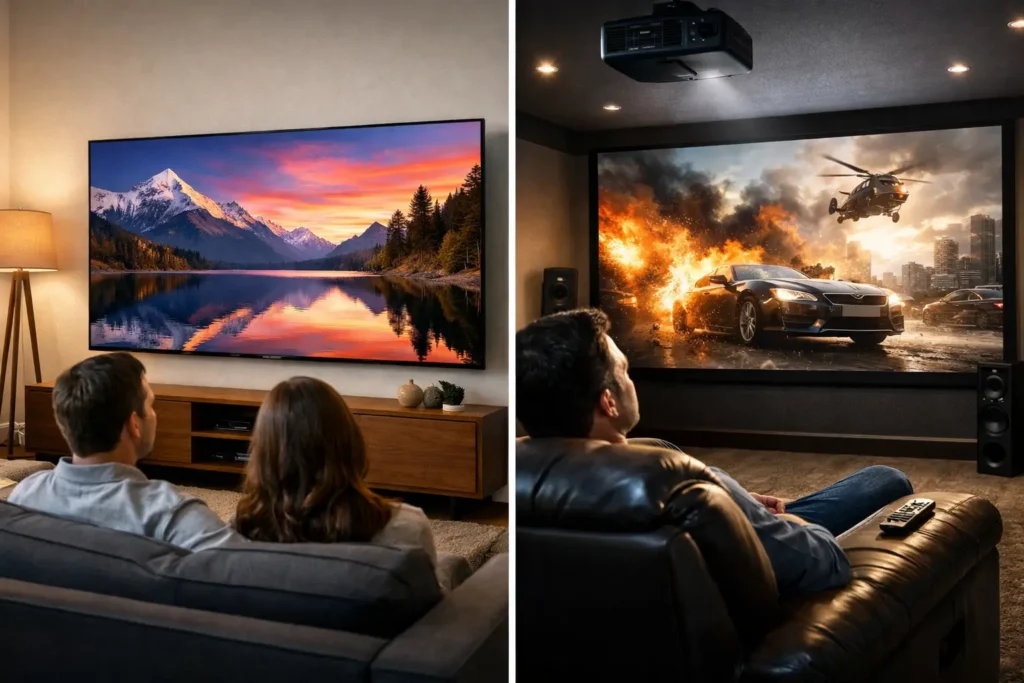
A 98-inch OLED can make a striking statement in a Newport Beach living room. A 120-inch projected image can make the same room feel like a private cinema. That is why the OLED versus projector room decision is not really about picking the “best” display. It is about choosing the experience that fits the room, the household, and the way you actually watch.
At Tri Star Home Theater, we see homeowners make the strongest decisions when they look beyond showroom specifications. Picture quality matters, but so do daylight, seating distance, wall layout, speaker placement, operation, and how much visual impact you want when the system is off.
OLED Versus Projector Room: The Core Difference
An OLED TV is a self-emissive display. Each pixel produces its own light, which creates deep blacks, strong contrast, and excellent detail in dark scenes. It is an especially dependable choice for mixed-use spaces where sports, news, streaming, gaming, and family viewing happen throughout the day.
A projector creates a much larger image by throwing light onto a screen. When the room is designed around it, a projector delivers the scale and cinematic feel that even the biggest TVs cannot fully duplicate. The trade-off is that a projection system depends more on the room. Ambient light, screen material, projector placement, and calibration all have a major effect on the final result.
For many homes, the question comes down to this: do you want a premium display that works beautifully at any hour, or do you want a dedicated viewing environment that feels bigger and more immersive?
Picture Quality and Bright-Room Viewing
OLED is the clear winner for contrast and consistency in a bright living room. Black areas of the image remain convincingly dark, colors are rich without much adjustment, and the screen can overcome daylight better than most projectors. If your theater shares space with large windows, glass doors, or an open kitchen, an OLED is usually the more forgiving option.
That does not mean a projector cannot work in a bright room. It simply needs the right supporting design. Motorized shades, blackout treatments, carefully selected screen material, and a higher-output projector can dramatically improve daytime viewing. In Southern California homes with generous natural light, those details should be part of the plan rather than an afterthought.
In a properly darkened theater, the comparison becomes more nuanced. OLED still has an advantage in absolute black level and fine HDR detail. A quality projector, however, can create a more relaxed, theater-like image at a much larger size. Many movie fans gladly accept a small compromise in black level for the impact of a 120-inch or 135-inch screen.
Screen Size Changes the Experience
The size advantage is projector territory. OLED TVs now reach impressive sizes, including 83, 97, and larger models, but the cost rises quickly as the screen grows. A projector and fixed-frame screen can often deliver 110 to 150 inches for a more practical system cost than an ultra-large OLED.
Size is not only about impressing guests. It changes how involved viewers feel in movies, concerts, and major sporting events. In a dedicated room with seating 10 to 14 feet from the screen, a 120-inch projected image often fills the field of view in a way that feels intentional rather than excessive.
Still, bigger is not automatically better. A screen that is too large for the seating distance can make subtitles tiring to follow and fast action harder to watch. The right size depends on the resolution of your content, the seating layout, and whether you prefer a cinematic view or a more casual TV-style experience. A site visit and measurement are worth more than a guess based on diagonal inches alone.
Room Design and Everyday Aesthetics
An OLED is usually easier to place. It can be mounted flush to the wall, framed by custom cabinetry, or positioned above a fireplace when heat and viewing height are handled correctly. When turned off, it remains visible, but modern slim TVs can integrate cleanly into a contemporary room.
A projector system can be almost invisible when designed well. The projector may be recessed, mounted neatly at the rear of the room, or placed in an equipment area. A motorized screen can disappear into a ceiling soffit, leaving the room open for daily living. A fixed-frame screen creates a more dedicated theater look and provides the best presentation for many installations.
This is an area where planning makes a real difference. Projector wiring, power locations, ventilation, and structural support should be considered early in a remodel. Retrofitting is certainly possible, but a clean installation may require low-voltage cable routing and creative concealment. With either display type, the goal is the same: equipment should support the room’s design, not take it over.
Sound Matters More Than Most Buyers Expect
A large picture without capable sound can feel underwhelming. This is particularly true with a projector, where the movie-theater effect invites a more complete surround sound system. A properly placed Dolby Atmos setup gives dialogue a clear center channel, adds convincing movement overhead, and provides the low-frequency impact that a soundbar alone cannot reproduce.
OLED rooms can benefit from the same approach. A TV does not limit you to TV speakers. In fact, a slim OLED paired with in-wall speakers, a concealed subwoofer, and a receiver or compact amplifier can keep a living room polished while producing excellent sound.
Projector rooms also require attention to equipment noise. The projector should be selected and positioned so fan noise does not distract from quiet scenes. Acoustic treatments, soft furnishings, and speaker calibration can further improve clarity without making the room look like a commercial cinema.
Budget: Compare the Complete System, Not Just the Display
The sticker price is only one part of an OLED versus projector room budget. With OLED, the display accounts for a significant share of the cost, especially above 83 inches. Installation may be comparatively straightforward if the wall, power, and cable path are ready.
With a projector, the projector itself is only one component. You may also need a screen, ceiling mount or recessed enclosure, AV receiver, source equipment, HDMI cabling, control system, lighting adjustments, and window treatments. A dedicated room can be a larger project, but it also gives you more flexibility to build a true theater over time.
Do not overlook maintenance and long-term use. Projector lamps, where applicable, eventually need replacement, while laser projectors offer much longer light-source life. OLED has no lamp to replace, but its performance is tied to display technology and use patterns. For typical home viewing, both can be excellent long-term choices when selected appropriately.
When an OLED Is the Better Choice
Choose an OLED if your room is bright, the system will be used frequently during the day, or you want exceptional image quality with minimal room modification. It is also a strong fit when you want a clean wall-mounted display for everyday streaming, gaming, and sports.
An OLED makes particular sense for family rooms and great rooms where convenience matters as much as performance. Turn it on, pick a source, and the picture looks good without closing shades or lowering a screen.
When a Projector Room Is the Better Choice
A projector is often the right answer when movies are the priority, the room can be darkened, and you want an image larger than 100 inches. It is ideal for dedicated media rooms, bonus rooms, and spaces where the seating can be planned around the screen.
It is also a compelling choice for homeowners who want a hidden-screen design. A motorized screen paired with a discreet projector can preserve a room’s architecture while creating a major entertainment upgrade at the press of a button.
The Best Answer May Be Both
Some homes do not need to choose only one. A large OLED can serve the main living area, while a projector system anchors a dedicated theater or upstairs media room. This approach separates everyday TV viewing from movie-night viewing and lets each display do what it does best.
Before buying equipment, have the room evaluated for ambient light, seating distance, wiring options, sound goals, and control needs. The right recommendation should feel tailored to your home, not driven by whichever display happens to be on promotion.
A well-designed theater should make it easier to gather, relax, and enjoy the content you love. Ready for a free consultation? Let’s get in touch! Call (949) 878-0531 Today