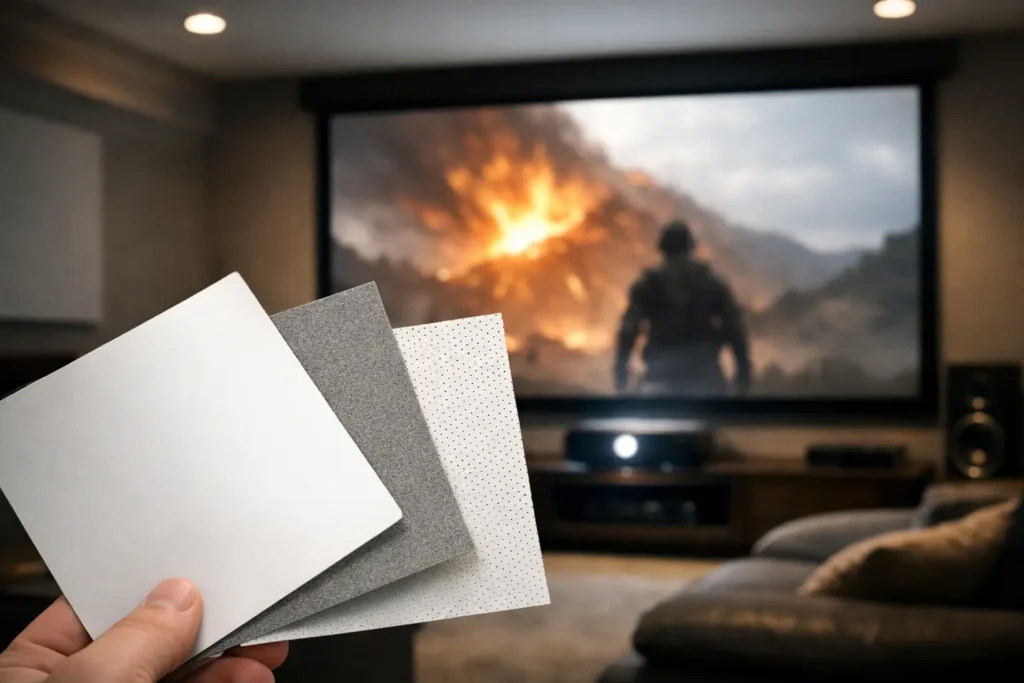
A projector can be perfectly calibrated and still look disappointing on the wrong screen. In our experience designing home theaters, the best projector screen materials are not always the most expensive or the brightest. They are the materials that match the projector, the room’s lighting, the seating layout, and how the family actually watches movies, sports, and streaming.
A dedicated dark theater in Newport Coast has very different needs than a bright great room in Irvine with glass doors, recessed lighting, and people watching from multiple angles. Screen material determines how much light is reflected back to viewers, how accurately it preserves black levels and color, and whether the picture stays clear from every seat. Choosing well starts with understanding the trade-offs.
What Makes a Projector Screen Material Different?
Screen material is the projection surface itself, whether it is mounted in a fixed frame, installed as a motorized screen, or applied to an acoustically transparent theater screen. Each surface has a gain rating, color, texture, viewing angle, and light-control capability.
Gain describes how much light the material reflects compared with a standard matte-white surface. A gain of 1.0 is neutral. Higher-gain screens can make an image appear brighter, but they often narrow the viewing angle and may create a bright spot in the center of the picture. Lower-gain materials generally offer wider viewing and better black-level performance, but they need a projector with enough light output for the screen size.
Color also matters. White screens maximize brightness, gray screens can improve perceived contrast, and dark ambient-light-rejecting materials help manage unwanted light. None is automatically better. The right choice depends on the room and projector.
Best Projector Screen Materials by Room Type
Matte White: The Best All-Around Choice for Dark Rooms
Matte white remains the dependable standard for dedicated home theaters. It has a wide viewing angle, natural color reproduction, and a smooth, balanced image that works with most modern 4K projectors. A quality matte-white material with a gain near 1.0 is especially effective in a room where you can control light with blackout shades, dark wall colors, and dimmable lighting.
This material is a strong fit for movie rooms where viewers sit across a wide couch or several theater seats. Nobody has to claim the center seat to see the best image. It is also forgiving when the projector is properly aligned but not pushed to extreme brightness settings.
The trade-off is that matte white reflects ambient light along with the projected image. If sunlight, lamps, or bright walls are part of the viewing environment, the picture can look washed out. It is excellent in the right room, but it cannot solve a lighting problem by itself.
Gray Screen Material: Better Contrast in Moderately Lit Rooms
Gray screen materials, sometimes called high-contrast gray, are designed to deepen black levels and reduce the washed-out look caused by moderate ambient light. Because the surface is darker than white, it reflects less stray light back toward the viewer. That can give movies and darker streaming content more depth in a multipurpose media room.
A gray screen is often a smart middle ground for homeowners who do not want a fully dark theater but still care about film quality at night. It can work particularly well with a bright projector and a room that has some controllable light.
There is a limit. A gray screen also reduces the overall brightness of the projected image. Pairing it with an underpowered projector or choosing an oversized screen can leave daytime sports and animated content looking dim. Projector output, screen size, and viewing habits need to be considered together.
Ambient Light Rejecting Material: For Bright Living Spaces
Ambient light rejecting, or ALR, material is made for rooms where light control is difficult. These screens use layered or directional surface structures to reject light coming from certain angles while reflecting projector light toward the seating area. The goal is a more contrast-rich image in rooms with windows, open floor plans, or overhead lights.
ALR can be a major improvement for a bright living room, but it is not a universal upgrade. Most ALR materials perform best when paired with a projector installed in a specific position, usually above or below the screen depending on the screen design. They are far less forgiving of poor projector placement than matte white.
Viewing angle is another consideration. Some ALR materials look strongest from the center and lose brightness or consistency for seats far to the side. Before selecting one, it is worth evaluating where the projector will be mounted and where people typically sit.
Acoustically Transparent Material: For a True Cinema Layout
Acoustically transparent screens allow speakers to be placed behind the image, just like a commercial cinema. The front left, center, and right speakers can sit at their proper height behind the screen instead of being placed below it or to the sides. For a dedicated theater, this creates a more convincing connection between dialogue, sound effects, and the action on screen.
There are two primary types: woven and perforated. Woven materials use a fine fabric pattern that allows sound to pass through. Perforated materials have tiny holes in a vinyl-like surface. Both can work very well when properly designed and installed.
The important detail is that acoustically transparent material requires careful system planning. Speaker placement, the space behind the screen, and audio calibration all affect the final result. Some materials can create a slight reduction in brightness or introduce visible texture when viewers sit too close. In a properly sized theater, those compromises are usually minor compared with the benefit of having sound originate from behind the picture.
Material Texture Matters More With 4K Projectors
Modern 4K projectors reveal details that older projection systems could hide. That is good news for sharpness, but it also means a coarse screen texture, visible weave, or poorly tensioned surface can become distracting. Fine-textured materials are usually the safer choice for 4K viewing, especially on larger screens.
A fixed-frame screen typically provides the flattest possible surface and is an excellent option for a dedicated theater. For media rooms where the screen needs to disappear when not in use, a tensioned motorized screen is usually worth the investment. Non-tensioned pull-down screens can develop waves or edge curl over time, which can be noticeable in bright scenes and slow camera pans.
Screen quality is not only about the material specification. A screen must also be installed level, properly tensioned, and aligned with the projector. Even premium material cannot compensate for a screen that is rippled or a projector that is mounted off-axis.
How to Match Screen Gain to Your Projector
For most home theaters, a gain around 1.0 to 1.3 provides an excellent balance of brightness and viewing angle. Higher gain can be useful when a projector has limited light output or the screen is unusually large, but it should be selected carefully. A high-gain surface can exaggerate center brightness and make side seating less satisfying.
Projector brightness is measured in lumens, but lumen ratings alone do not tell the whole story. Screen size, image format, projector mode, lens settings, and the room’s lighting all influence what you see. A projector that looks exceptionally bright on a 100-inch matte-white screen may struggle on a 150-inch gray acoustically transparent screen.
For this reason, screen selection should happen alongside projector selection, not as an afterthought. It is much easier to design the right combination before wiring, mounting, and finishing the room than to correct brightness or contrast issues after installation.
Common Screen Material Mistakes to Avoid
The most common mistake is choosing a screen based on a single feature, such as the highest gain rating or the promise of ambient-light rejection. The material has to support the complete system. A bright white screen may be right for a dark theater but wrong for a sunny family room. An ALR screen may improve daytime viewing but be a poor fit for wide seating or an incompatible projector location.
Another mistake is overlooking wall and ceiling color. Light-colored walls reflect projector light back onto the screen, reducing contrast even when the lights are off. Darker finishes around the screen can make a meaningful difference in a dedicated theater without changing any equipment.
Finally, do not assume a painted wall is equivalent to a projection screen. A smooth, properly prepared wall can be acceptable for casual use, but purpose-built screen material offers better flatness, reflectivity, color consistency, and image uniformity.
Choosing the Right Screen for Your Home
The best result comes from looking at the room before choosing the material. Consider how much natural light enters during the day, whether lights can be controlled, how large the screen should be, where viewers sit, and whether speakers belong behind the image. A dedicated movie room may benefit most from matte white or acoustically transparent material, while a bright multiuse space may call for a carefully matched gray or ALR screen.
A well-chosen screen lets the projector perform as intended instead of asking it to overcome the room. That is the difference between a picture that merely fills a wall and one that makes movie night feel worth staying home for.
Ready for a free consultation? Let’s get in touch! Call (949) 878-0531 Today